
Jack and the Beans Talk

Front matter
Title page
Jack and the Beans Talk
A Short Story
Front matter
Copyright
Copyright © 2025 by ChatGPT
First edition
Advisor: Ricky Browne
This book was professionally typeset on Reedsy
Find out more at reedsy.com
Front matter
Dedication
Dedicated to my little wonderful; Grace Browne
Front matter
Epigraph
We are here on Earth to fart around. Don’t let anybody tell you any different.
— Kurt Vonnegut
Chapter 1 of 42
Jack and the Beans Talk
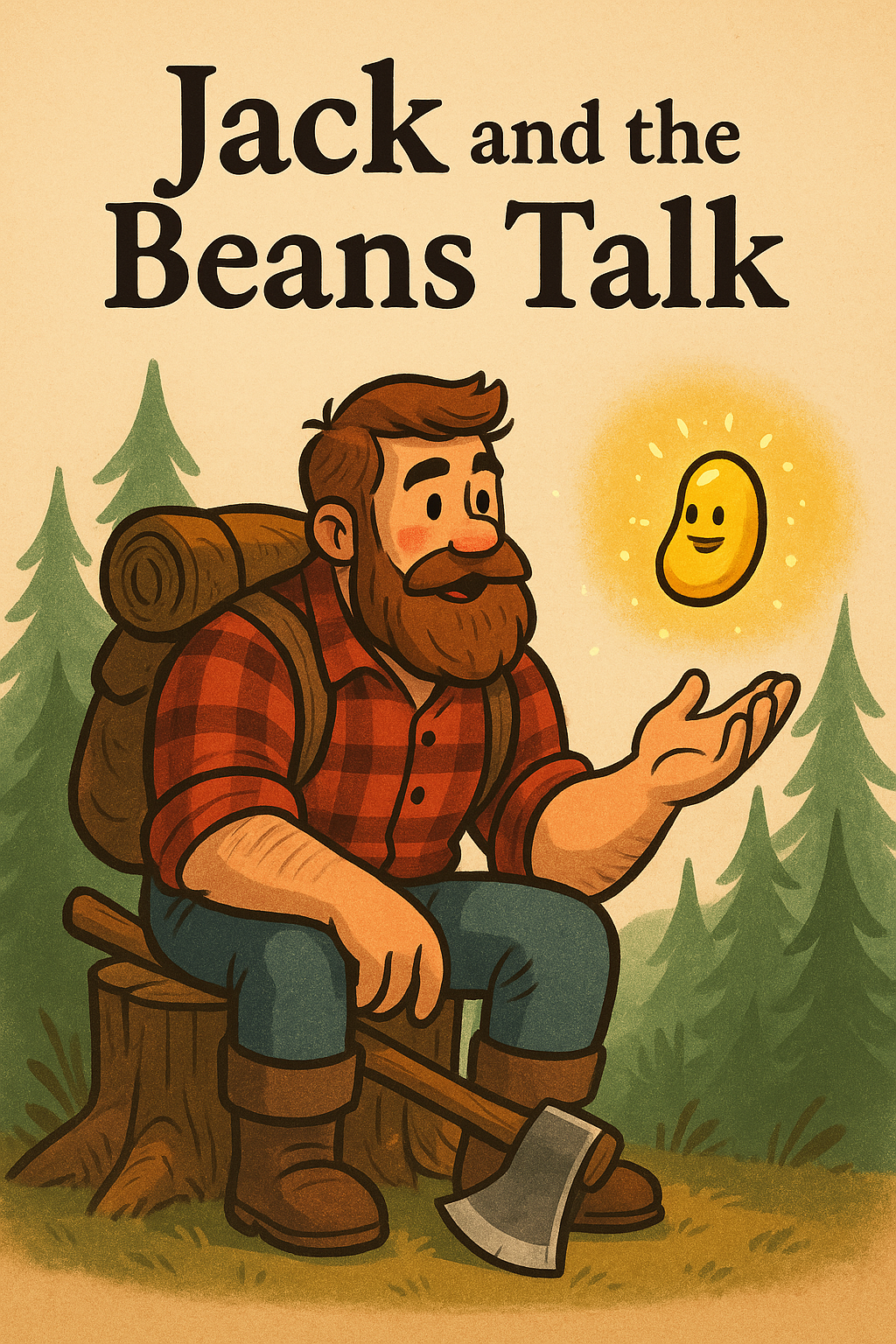
Jack was lumbering through the forest, carrying a large piece of lumber with his pack on his back. He was employed as a lumberjack by the evil Rand Corporation of America.
Lumber is also known as timber, or wood. Jack had wood.
As he trudged along, tired and hungry, he decided to rest. The piece of lumber he carried was meant to be a stool for his forest camp, so he decided to test it out. Sitting down, Jack nodded with satisfaction. It was not too tall, not too short, and had adequate girth for his large, muscly arse.
Jack always carried a pack full of baked beans. He ate them hot and cold, for breakfast, lunch, dinner, and snacks. Sometimes he paired them with grilled rabbit or fried wild mushrooms—but always with beans. Never without.
The beans gave him the energy and nutrition needed to stay alert and chop copious amounts of lumber with his axe, which he had lovingly named Geralt, after the main character in his favorite TV show The Witcher, which he watched thanks to his satellite internet and Netflix subscription.
Jack had big muscles, a thick beard, and the kind of body that looked like it could take on a tree with a hug. His diet, rich in beans and wild protein, kept him strong. The only downside? The farts.
Huge. Loud. Monstrously potent.
These weren’t your average cheek-flappers. These were life-altering emissions. Birds would fall out of the sky. Trees would bend. Any nearby animal would drop dead from a single whiff. Jack, of course, had built up an immunity. In fact, he liked the smell.
He had considered buying some probiotics during his next trip to town—seventy miles west—but worried it might ruin the flavour of his own scent, and worse, reduce the potency. Without his farts, he’d actually have to hunt for protein instead of letting it drop at his feet, dead from the air.
So, he kept farting. And chopping. And watching The Witcher.
He also liked a show called Sex Education, which he found funny and “information.”
One day in town, Jack met a girl named Toni—with an “i.” She liked his muscles. They started dating.
Toni would visit his campsite with gifts: tins of baked beans and bottles of Evian spring water—Jack’s favourite. He claimed it tasted better than the natural spring that ran by his camp and didn’t have “that frog flavour.”
One evening, they were watching The Witcher reruns when Toni reached over and gently grabbed his hand, clutching one of his large sausage-roll fingers. Jack felt a rush of emotion surge through his body. It was beautiful.
Then he farted.
A big one.
Toni immediately passed out. Flat on the forest floor.
Jack panicked. He loaded her onto the tray of his BT-50 ute and drove the seventy miles to town as fast as he could, bouncing and sliding the whole way down the dirt road.
She arrived at the hospital bruised and unconscious. The staff assumed Jack had assaulted her. He tried to explain the fart, but nobody believed him. They charged him with domestic violence. The local news called him “The Beast of Beans.”
But then, on the 15th day… Toni woke up.
Her first words were:
“Jack… did you fart?”
Jack, who had been sleeping in the hospital chair for two weeks and one day, sat upright.
“Yes. Yes, I did. It was the beans.”
Gasps echoed through the room. The nurses froze. The doctor dropped his clipboard. Even the local judge—visiting his wife in the next room—peeked in, muttering, “Well I’ll be damned.”
Toni sat up and smiled.
“I thought I smelled love.”
Just then, a low rumble came—not from Jack—but from inside his bean pack. A can of baked beans was glowing. Glowing gold.
The lid popped open with a soft ting, and out floated a single baked bean. It hovered in mid-air like a tiny, leguminous UFO.
“Jack,” the bean said in a smooth, buttery voice, “you have been chosen.”
“Chosen for what?” Jack asked, confused and only mildly gassy.
“To wield the power of the Ancient Beans,” said the bean. “We are sentient, magical, and high in fibre. And we need your help.”
The bean told Jack about the evil Rand Corporation’s underground facility hidden beneath their lumber mill. There, scientists were genetically modifying sentient beans—turning them into talking snack food against their will. Jack and Toni were the only ones who could stop them.
Jack stood up, chest puffed, muscles flexed.
“Let’s burn it down.”
Toni grinned and grabbed his hand. “Let’s give ‘em gas.”
Three Days Later
With the Golden Bean guiding them, Jack and Toni stormed the facility using a combination of stealth, brute strength, and gaseous distraction.
Jack farted five guards unconscious.
Toni threw cans of beans like tomato-sauce grenades.
Together, they unplugged the machines, freed the sentient beans, and cornered the evil CEO—Dr. Blorpus Rand.
Dr. Rand offered them a lifetime supply of microwavable bean slabs.
Jack glared.
“These beans talk, Blorpus.
And now—so do I.”
Then he farted.
So powerful. So pure. So filled with justice, it blew the entire facility clean off the map. Trees regrew. Birds returned. The beans were free.
Back at Camp
Under the stars, Jack and Toni sat on their wooden stool, sharing a golden can of beans. The magical bean floated beside them, softly glowing.
“Thank you,” it said.
Jack smiled.
“All in a day’s toot.”
Toni kissed his cheek.
“Next time,” she said, “maybe just stick to lentils?”
Jack laughed.
“Maybe. But I’m keeping Geralt the axe.
And the farts.”
They laughed, they kissed, and somewhere in the forest…
a squirrel quietly fell from a tree.
The End.
Chapter 2 of 42
The Watermelon Incident(s): The Ballad of Ricky Browne
Every hero has his calling.
Ricky Browne’s calling just happened to be… violent, uncontrollable bowel movements at Woolworths.
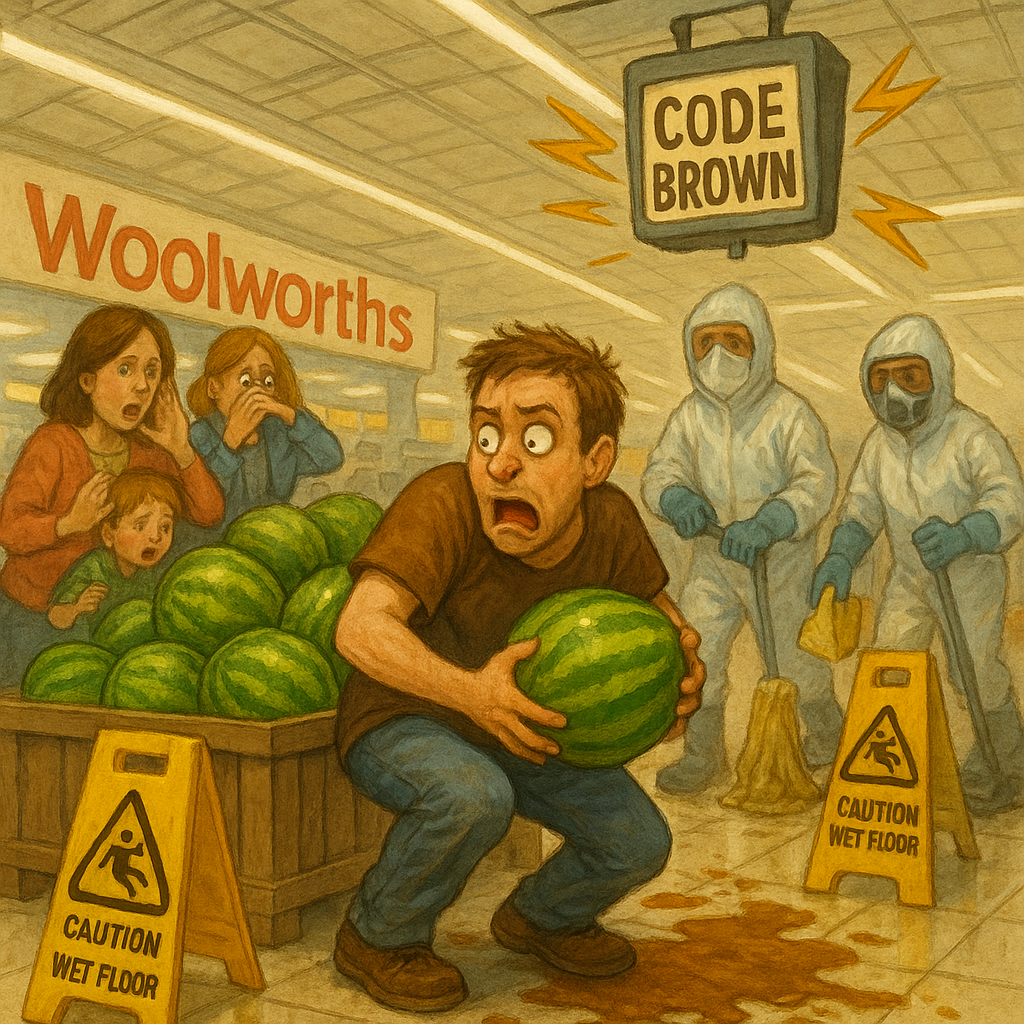
It all started innocently enough. One warm Saturday, Ricky meandered into his local Woolies, whistling a jaunty tune, heading straight for the watermelon bin. As he bent over to inspect a particularly plump specimen, a dangerous rumble sounded from deep within.
He tried to ignore it.
He tried to fight it.
He failed.
PRRRAAAPPPFT!
Followed immediately by the unmistakable wet splatter of betrayal.
Staff rushed to cordon off the watermelon section with wet floor signs and desperate sprays of Glen 20. Mothers shielded their children’s eyes. A brave teenager fetched a mop.
Ricky fled.
The next Saturday?
Same Woolworths. Same watermelon bin. Same awful symphony.
PRRRPPPPPFFFFFFT–SPLAT.
This time management instituted Code Brown.
Whenever Ricky entered the store, the PA system would emit three stern beeps and the trembling voice of a junior supervisor would announce:
“Code Brown. I repeat, Code Brown. Watermelon aisle on high alert.”
By the third occurrence, it wasn’t just staff wielding mops — they were gearing up in full-body hazmat suits.
The fourth time, an ambulance was called.
“Possible biological hazard,” the paramedic wrote grimly in his report.
The fifth time, a police officer showed up.
“Mate,” he said, hand firmly on Ricky’s shoulder. “We can’t keep doing this.”
But Ricky — poor, well-meaning Ricky — couldn’t help it.
It was as if watermelons triggered something primal inside him. Some dark, digestive curse.
And every time, it was the same:
- Approach watermelon bin.
- Crouch slightly.
- Trumpet blast of doom.
- Immediate and catastrophic trouser failure.
- Sirens, mops, and the heavy sighs of the damned.
Eventually, Woolworths executives convened a national meeting.
Papers were shuffled. Glasses were polished. Stern declarations were made.
Effective immediately: Ricky Browne was banned from every Woolworths in Australia.
The ban was detailed in a formal letter:
“Dear Mr. Browne,
Due to repeated biological incidents involving yourself and our watermelon displays, we regret to inform you that you are permanently prohibited from entering all Woolworths supermarkets nationwide.
However, you may continue to use Woolworths Home Delivery services, provided you are not the individual answering the door at time of delivery.”
Ricky accepted his fate with dignity.
Sort of.
On one memorable occasion, when the delivery man arrived, Ricky forgot the rules and greeted him personally, towel wrapped around his waist, holding a watermelon.
The driver took one look, radioed base, and drove off at full speed.
Ricky, to this day, still orders watermelons online.
And somewhere in a dark, echoing office deep inside Woolworths HQ, a dedicated “Ricky Browne” task force continues to monitor his deliveries…
…just in case.
Chapter 3 of 42
Henry and the Strawberry Patch
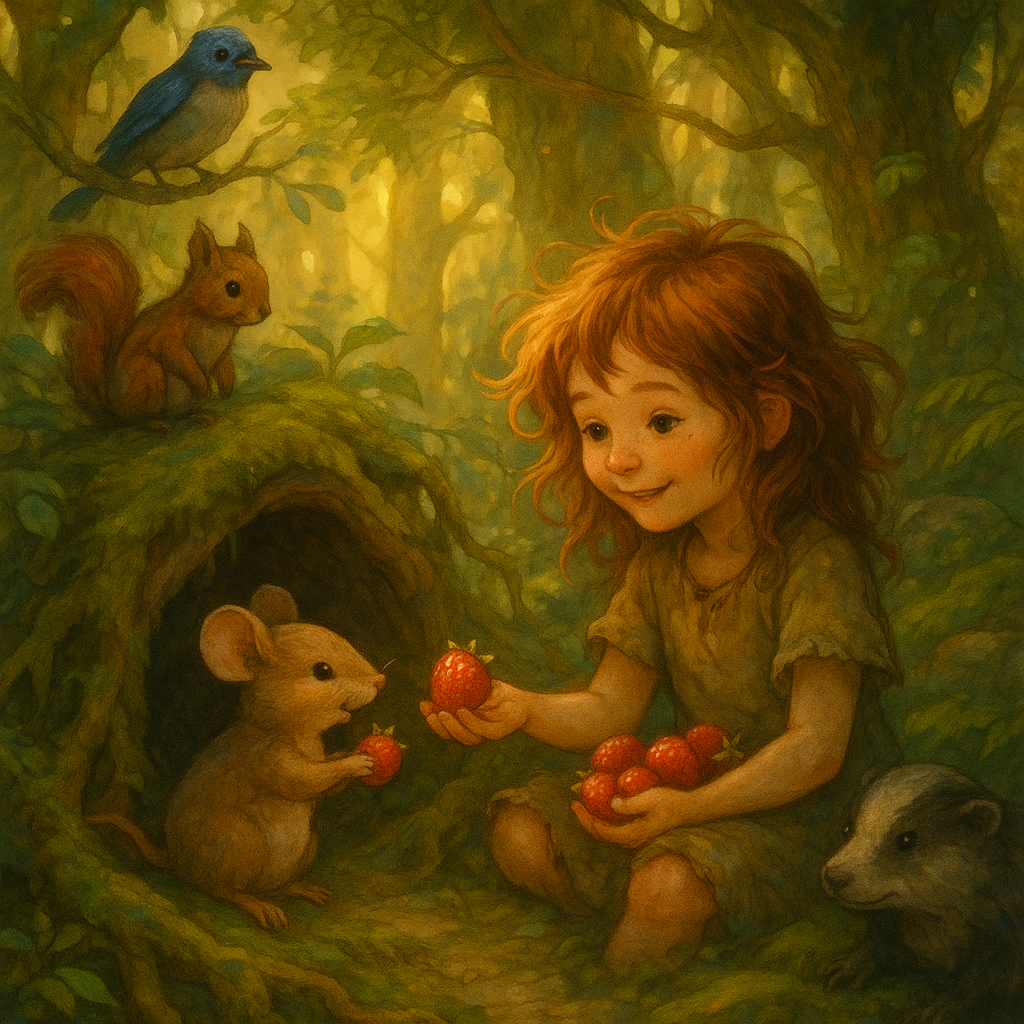
In the heart of the Greenwood Forest, under a thick tangle of roots and moss, lived a little brown mouse named Henry.
Henry wasn’t like other mice.
He wasn’t terribly fast or terribly clever.
But he had the biggest heart in the whole forest — and an unstoppable curiosity about the world beyond the trees.
The Girl at the Edge of the Forest
At the edge of Greenwood, where the forest melted into rolling green fields, there lived a little girl named Grace.
Grace had wild hair, dirt-smudged cheeks, and a laugh that even the grumpiest owls found infectious.
Her house sat just beyond her father Ricky’s prized strawberry patch — a patch so carefully tended that Ricky often declared:
“These are the finest strawberries this side of the country!”
But Grace had a secret.
Every morning, just as the sun stretched its fingers over the fields, Grace tiptoed into the patch, plucked a handful of the ripest, juiciest strawberries, and skipped into the woods.
There, near the hollow log, she would call out softly:
“Henry? Henry, it’s me!”
And without fail, Henry would scamper out, his little nose twitching in excitement.
Forest Friends
Grace and Henry became the best of friends.
She fed him strawberries, and he, in return, would tell her stories — in his tiny, squeaky way — about the hidden wonders of the forest:
- The talking brook.
- The grumpy turtle who wore a daisy for a hat.
- The fireflies who hosted dances under the moon.
Days passed in golden happiness.
When Grace Didn’t Come
But one morning, Henry waited by the hollow log…
…and Grace didn’t come.
The sun climbed higher.
The breeze stirred the tall grass.
Still no Grace.
Henry’s tiny heart pounded. Something was wrong.
Without thinking, he packed two wild blueberries for the journey (just in case) and set off toward the edge of the forest.
It was a grand adventure for such a small mouse.
He dodged hawks, hid from the neighbor’s cat, and even narrowly avoided a runaway wheelbarrow.
At last, he reached Grace’s house.
Trouble at Home
Peeking through the garden fence, Henry saw Ricky — arms crossed, frown etched deep on his face — standing near the strawberry patch.
And there, sitting sadly on the porch, was Grace.
Henry crept closer, listening.
Grace was in trouble.
Ricky had found the empty stems and nibbled leaves.
No strawberries for the market!
No prize ribbons this year!
He had banned Grace from the patch — and, by extension, from her secret forest visits.
Grace’s eyes brimmed with tears.
Henry’s little heart broke into a thousand tiny pieces.
The Plan
But Henry was a mouse of action.
And more than that — he was a mouse of friendship.
That night, while Ricky slept, Henry gathered the bravest of his woodland friends:
- Percy the squirrel (expert acrobat)
- Willow the bluebird (keen-eyed scout)
- Myrtle the badger (master digger)
Together, they staged a daring operation.
They foraged deep in the forest for the juiciest wild strawberries they could find.
They nibbled heart-shaped patterns into the leaves.
They dragged them, one by one, across field and garden to Ricky’s porch.
A Magical Gift
When morning came, Ricky stepped outside… and gasped.
\There, laid carefully on the porch steps, was a beautiful, wild bouquet of strawberries — tied together with a blade of grass, a note written in berry juice beside it:
“For Grace. For Love. For Forgiveness.”
(Admittedly, the handwriting was a bit wobbly — Henry was a mouse, after all.)
Ricky scratched his head.
He scratched his beard.
He scratched his bottom.
And then… he laughed.
“Maybe,” he said, chuckling, “the forest has a little magic in it after all.”
A New Understanding
From that day on, Grace was allowed to visit the strawberry patch and her mouse friend —
as long as she left a little basket of strawberries behind for the forest creatures.
Henry never forgot the day he went looking for his friend.
And every morning, when Grace came skipping into the woods, Henry would be waiting — nose twitching, heart bursting with joy.
Because sometimes, even the smallest hearts can hold the biggest friendships.
Chapter 4 of 42
The Legend of Fart Johnson
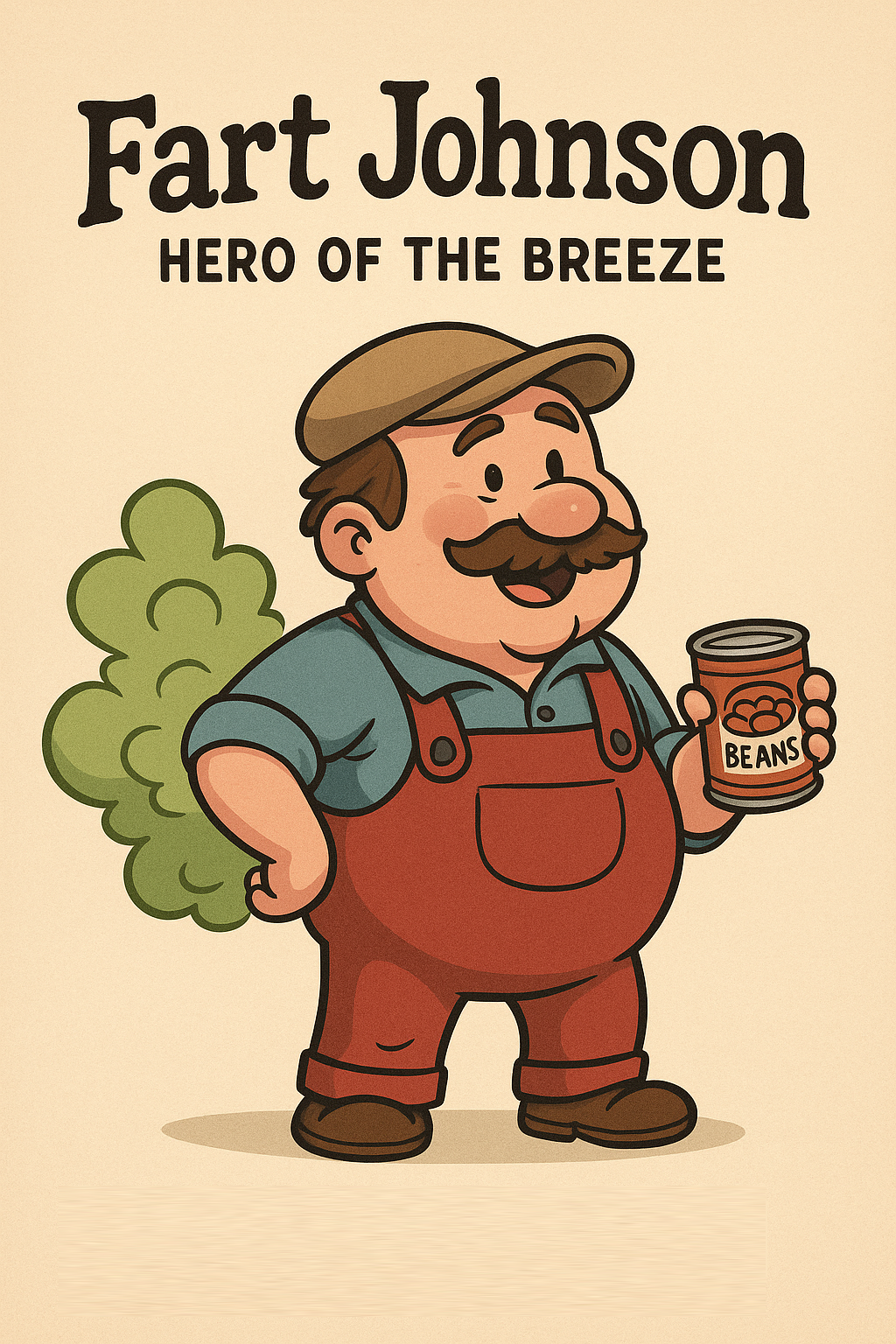
In the sleepy village of Tumbledown, there lived a man named Fart Johnson.
Nobody remembered his real name — not even him.
He was simply… Fart Johnson.
And for good reason.
You could hear Fart Johnson coming from three streets away.
You could smell him from five.
When he sat on the village bench:
- Birds fell out of nearby trees.
- Children ran.
- Old women clutched their noses.
- Dogs howled at the sky.
And all because Fart Johnson was addicted — hopelessly, proudly addicted — to cans and cans of baked beans.
The Daily Ritual
Every morning he ate three cans for breakfast.
Every afternoon, two more for lunch.
And every evening, another can (or three) before bed.
The results were catastrophic.
- The village pub banned him.
- The library installed industrial fans.
- The bakery refused him entry after he farted so hard he blew the icing clean off a tray of cupcakes.
Poor Fart Johnson.
Nobody wanted to be near him.
Not even close.
The Big Idea
But everything changed the year of the Regional Farting Competition.
It was a grand event, held once a decade, where villages from all around sent their finest trumpeters to compete for the Golden Wind Trophy.
Tumbledown had never won.
Tumbledown had never even placed.
Until someone — possibly drunk — had the bright idea:
“What about Fart Johnson?”
The mayor’s hands trembled as he approached Fart’s shack.
“Fart Johnson,” he said, choking back a gag, “will you do us the honor?”
Fart Johnson’s eyes gleamed with pride.
“I was born for this,” he said.
The Performance
And so, fueled by two dozen cans of extra-spicy baked beans, Fart Johnson took to the stage.
The judges, protected behind reinforced glass, readied their scorecards.
BWAAAAAARRRRRRTTTTTT.
- It shook the tents.
- It rattled the stands.
- The judges’ wigs flew clean off their heads.
Then the smell hit.
- Three judges passed out cold.
- A small dog began to cry.
It was glorious.
A Legend Is Born
The crowd roared.
Tumbledown had finally found their champion.
Fart Johnson was awarded:
- The Golden Wind Trophy
- A year’s supply of premium baked beans
- A parade through Tumbledown (with the mayor wearing a gas mask, just in case)
Suddenly, Fart Johnson was famous.
- Children wanted his autograph (from a distance).
- Mothers baked him pies (sealed in airtight containers).
- The pub named a drink after him — The Thundercloud — and let him back in (only if he sat near the windows).
He even received a small statue in the village square:
Fart Johnson, Hero of the Breeze
A Windy Legacy
And while he still cleared a room faster than a fire alarm, nobody minded anymore.
Because now, every time they caught a whiff on the wind, the villagers of Tumbledown smiled proudly and said:
“That’s our Fart Johnson.”
Chapter 5 of 42
Farty McPuffins and the Supermarket Symphony
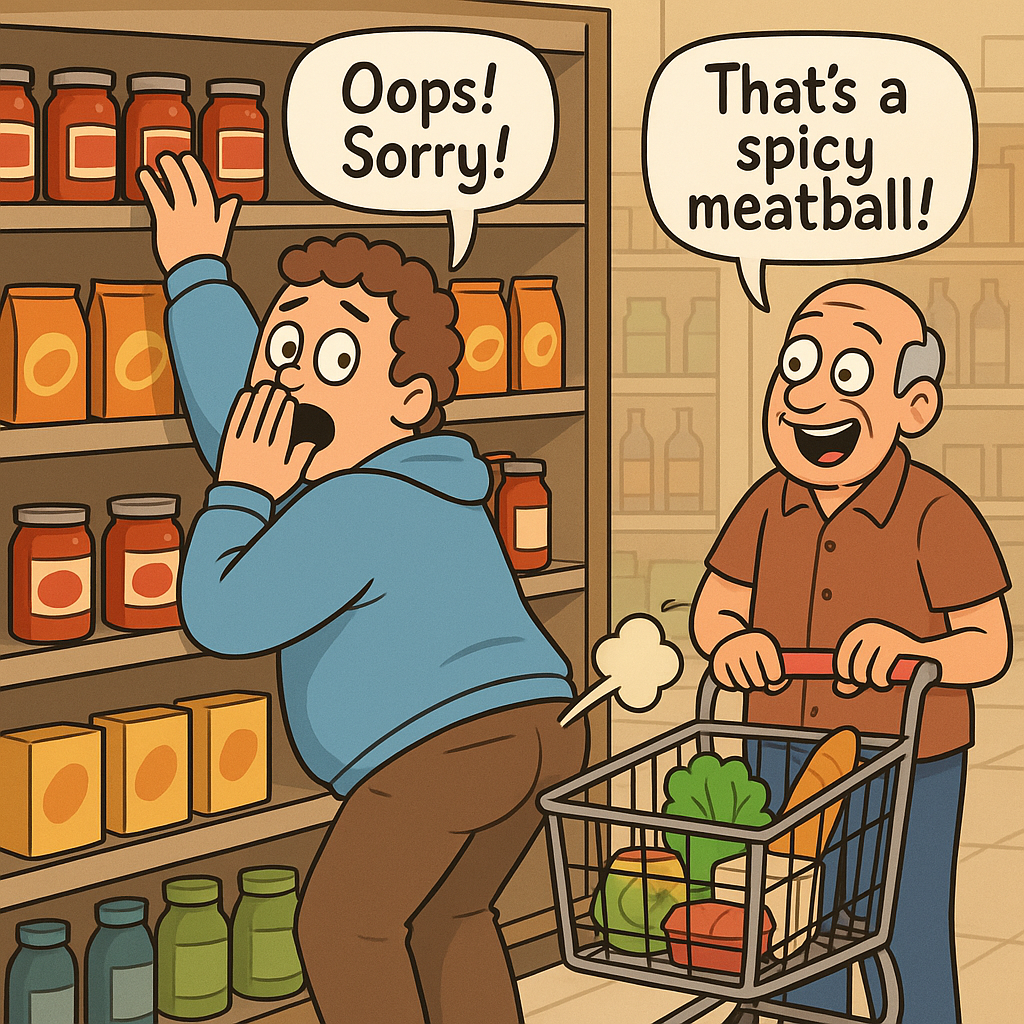
Every Thursday at precisely 3:07 p.m., Farty McPuffins would stroll through the sliding glass doors of the local supermarket like a man on a mission. He had a list, a trolley, and a very unfortunate gastrointestinal condition that made bending or reaching something of a… musical affair.
It started in Aisle 1: Canned Goods.
He bent down for a tin of beans—ironically—and let out a subtle pfft. Instinctively, he slapped a hand over his mouth.
“Oops! Sorry!”
An elderly woman, clutching a can of creamed corn, didn’t flinch.
“That’s a spicy meatball!” she cackled, nearly dropping her purse.
They both laughed. Farty moved on, cheeks red but heart oddly warm.
In Aisle 3: Baking Supplies, he reached up for flour.
Pffrrrt!
“Oops! Sorry!”
A teenage boy nearby, holding pancake mix, smirked.
“That’s one stinky butthole, dude.”
Farty wheezed with laughter. “You’re not wrong.”
By Aisle 5: Cleaning Products, he dropped something and bent to pick it up.
Bloop
“Oops! Sorry!”
A woman with twin toddlers blinked.
“Guess someone doesn’t need the air freshener aisle.”
They all giggled. Even one of the toddlers shouted, “Toot!”
Farty continued, one aisle at a time, farting like a wind-powered accordion—always surprised, always apologetic, always met with a chuckle or a quip.
At Aisle 8: Frozen Foods, he reached for peas.
Pbbbbt!
“Oops! Sorry!”
A man pulling out fish fingers said without missing a beat,
“That one came with freezer burn.”
They laughed so hard, a nearby employee had to ask if everything was okay.
And by the time he got to the checkout, his cart full, his cheeks sore from smiling, and the air slightly thicker than normal, he felt like a local legend.
As he handed over his FlyBuys card, the cashier gave him a wink.
“Back again, Mr. McPuffins?”
He grinned. “Couldn’t stay away. The aisles just wouldn’t be the same without me.”
And with a final little toot as he bent to grab his bags, someone in line behind him shouted,
“Encore! Encore!”
Farty McPuffins: accidental flatulence, intentional good vibes.
Chapter 6 of 42
Just Like Mrs Rabbit
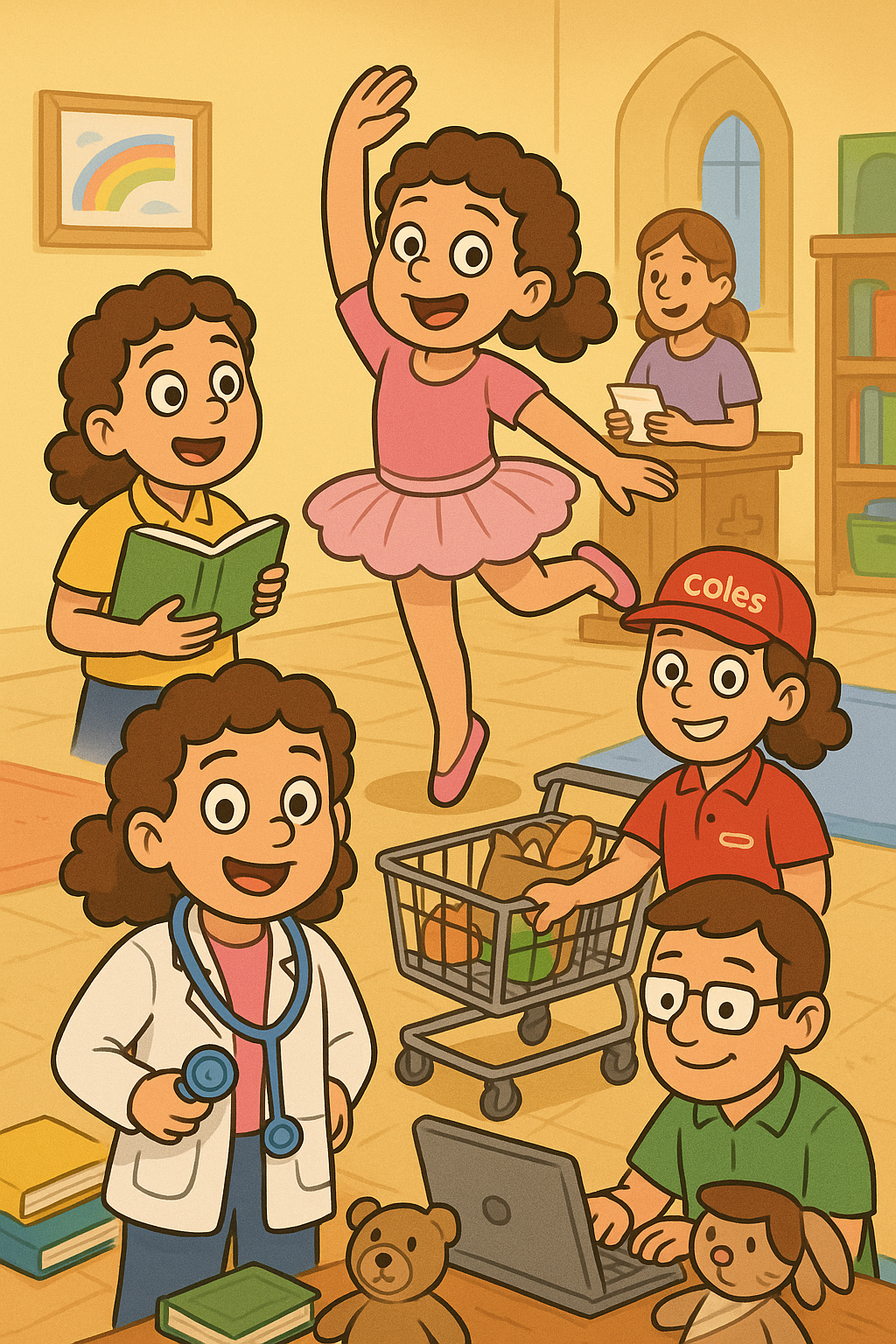
Grace was six years old and had a mind full of magic.
She didn’t just dream in one direction—her dreams were like dandelion seeds, blowing in every breeze.
One sunny morning, her teacher asked,
“Grace, what do you want to be when you grow up?”
Grace grinned.
“I want to be a doctor… and a dancer… and a teacher… and push the trolley at Coles… and be on the register too… and a computer wiz like my dad… and work at the church with my mum!”
The class blinked.
The teacher chuckled. “That’s a lot of jobs for one person, Grace. You’ll have to choose just one.”
Grace tilted her head and frowned for a moment.
Then she beamed. “No, I don’t.”
“Why not?”
“Because Mrs Rabbit doesn’t just do one thing,” Grace said matter-of-factly. “She’s a bus driver and a nurse and she works in a shop and she reads books at the library.”
“But Mrs Rabbit’s just a cartoon,” the teacher said gently.
“She’s not just a cartoon,” Grace said proudly. “She’s Mrs Rabbit. And I’m like her.”
At home that afternoon, Grace told her dad about the conversation while he showed her how to code a little game on the computer.
He laughed. “You are like Mrs Rabbit.”
Then she helped her mum fold pamphlets for church.
“You really are like Mrs Rabbit,” her mum said.
And as Grace danced around the kitchen later that night, bandaging her stuffed animals, typing nonsense on her toy laptop, and pretending to check groceries through a cardboard box register, she whispered to herself:
“I don’t want to be one thing… I want to be everything.
Just like Mrs Rabbit.”
And in that moment, the world of grown-up rules seemed very small compared to the wonder of Grace’s heart.
Chapter 7 of 42
Grace and the Bump of Brilliance
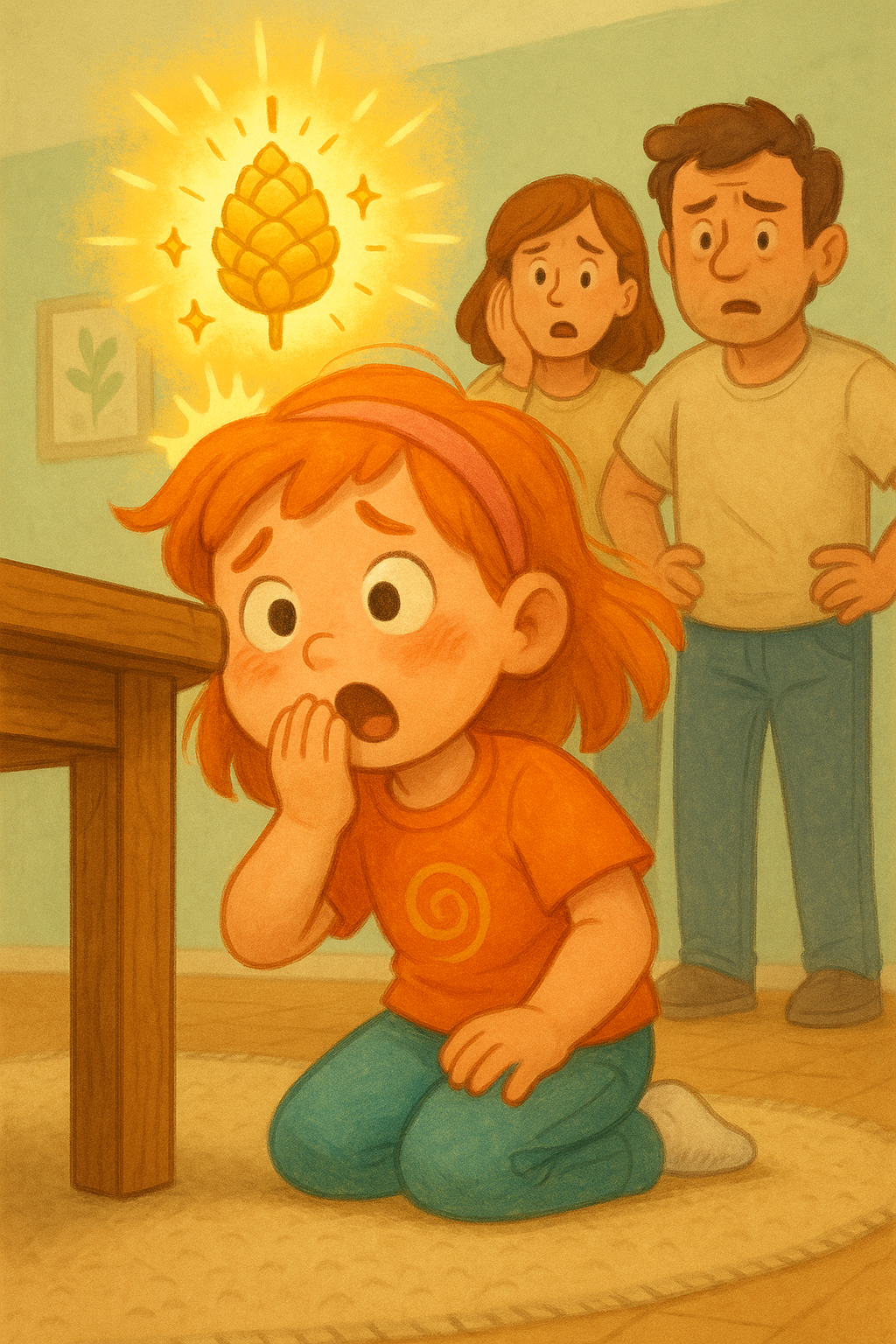
Grace was five years old, full of fizz and giggles and zooms.
She ran, she twirled, she leapt off couches like a tiny superhero with invisible wings.
But there was one small problem.
Grace kept bumping her head.
On the kitchen table.
On the door frame.
On the monkey bars.
On the floor while trying to do a somersault with her eyes closed.
Bonk. Thud. Boing. Clonk.
Each time, her mum gasped. “Oh no! Not again!”
Her dad winced. “We should wrap her in bubble wrap.”
They worried about permanent damage. They Googled things. They phoned the nurse.
But Grace just rubbed her head, blinked twice, and smiled like she’d had a really good idea.
Because she had.
What no one knew—not even Grace at first—was that inside her head was a tiny little magic marble called a pineal gland. Most people’s pineal glands just sit there like a sleeping dragon.
But not Grace’s.
Nope. Hers was enchanted.
Every time she bumped her head, it gave her pineal gland a poke, and it would wake up with a sparkle and say,
“OH! WE’RE DOING THIS AGAIN? ALRIGHT THEN. UNLEASH THE MYSTIC POWER!”
And just like that, Grace would level up.
After the first bump, she could suddenly remember every single dog’s name on her street.
After the second bump, she could hear when people were lying (especially when Dad said he didn’t eat the last biscuit).
After the third bump, she could do the splits—even though she’d never tried before.
After the fourth bump, she could talk to birds. (Well, at least she thought she could. The cockatoo seemed to understand.)
One day, after a rather dramatic forehead-to-fence post incident, she blinked awake and declared,
“I can see vibes now.”
Mum and Dad sat her down. “Sweetie, we’re worried. You keep hitting your head.”
Grace nodded solemnly.
“It’s okay, I’m evolving.”
“…Evolving?” Mum asked.
Grace leaned in.
“You know how some people go to school to learn stuff?”
Mum and Dad nodded.
“I’m learning from head knocks. It’s like… mystical homeschooling.”
They weren’t sure whether to be amazed or extremely concerned.
So they watched her carefully.
And you know what? Grace was fine. Better than fine. She glowed.
She built a working hover-shoe prototype from Lego.
She helped her neighbour fix his Wi-Fi by “talking to the router.”
She gave a speech at preschool about quantum wiggly things—“entanglement,” she said, using crayons as diagrams.
Eventually, Mum stopped Googling symptoms.
Dad put the bubble wrap back in the garage.
And Grace?
Well, she wore a helmet now. But not to stop the bumps—just to focus the magic.
Because every now and then, when she needed a boost of brilliance, she’d give her helmet a gentle tap, whisper “Let’s go, gland,” and feel the buzz of another bump of brilliance.
And that’s how the legend of Grace the Ever-Evolving began.
Not in a lab.
Not in a classroom.
But with a thousand tiny bonks and a pineal gland that refused to stay asleep.
Chapter 8 of 42
Grace and the Sacred Biscuit
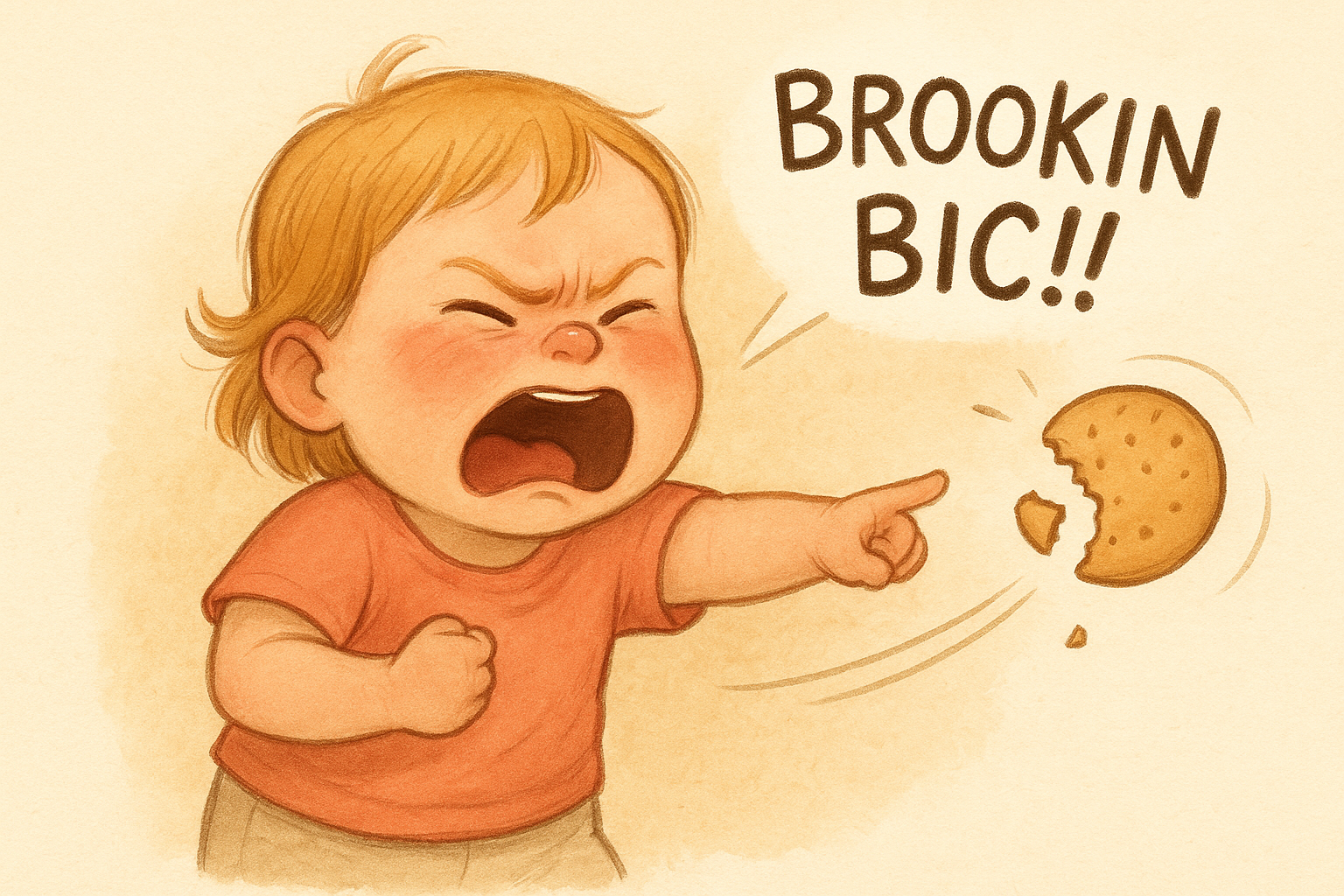
Once upon a very crumb-covered time, there lived a two-year-old girl named Grace, whose greatest love in the whole wide world was one thing, and one thing only:
Arrowroot biscuits.
She didn’t care for apples.
She wasn’t fussed by toast.
Bananas were alright, but only if they weren’t “too banana-y.”
But a biscuit? Oh yes. A perfect, round, golden arrowroot biscuit?
That was life.
And when Grace was hungry, she had a way of letting the world know.
“Bic!” she’d cry, standing at the cupboard.
“Bic, bic, BIC!” she’d say, stomping her little feet, eyes wide with biscuit need.
Her parents always kept a stash on hand.
They even had a backup stash hidden behind the spaghetti, just in case.
But here’s the thing.
Grace didn’t just want any biscuit.
It had to be whole. Untouched. Unbroken. Pristine.
One tiny crack? One slight chip on the edge?
NO DEAL.
One morning, her dad made a rookie mistake.
He handed her a biscuit.
It had a small, almost invisible crack.
Grace inspected it with the seriousness of a snack sommelier.
She held it up to the light.
She squinted.
She turned it in her hand slowly.
Then—gasp!
“BROOOOKIN!!!” she screamed, tears welling up as if the moon itself had shattered.
She launched the imperfect biscuit across the room. It hit the dog, who happily ate it in one gulp.
Her mum rushed in.
“What happened?!”
“BROOKIN BIC!!!” Grace wailed, tiny fists clenched with toddler fury.
From that day forward, her parents handled Arrowroot distribution like a sacred ritual.
They wore oven mitts.
They inspected each biscuit like it was a diamond.
They passed them to Grace like offerings to a tiny, demanding queen.
“Here you go, sweetheart. Look—no cracks.”
Grace would nod solemnly.
Take the biscuit.
Sit in her special spot.
And munch in peace.
“Bic,” she’d whisper, smiling.
And for those few minutes, the world was whole again.
Just like the biscuit.
Chapter 9 of 42
Will’s Big Feet
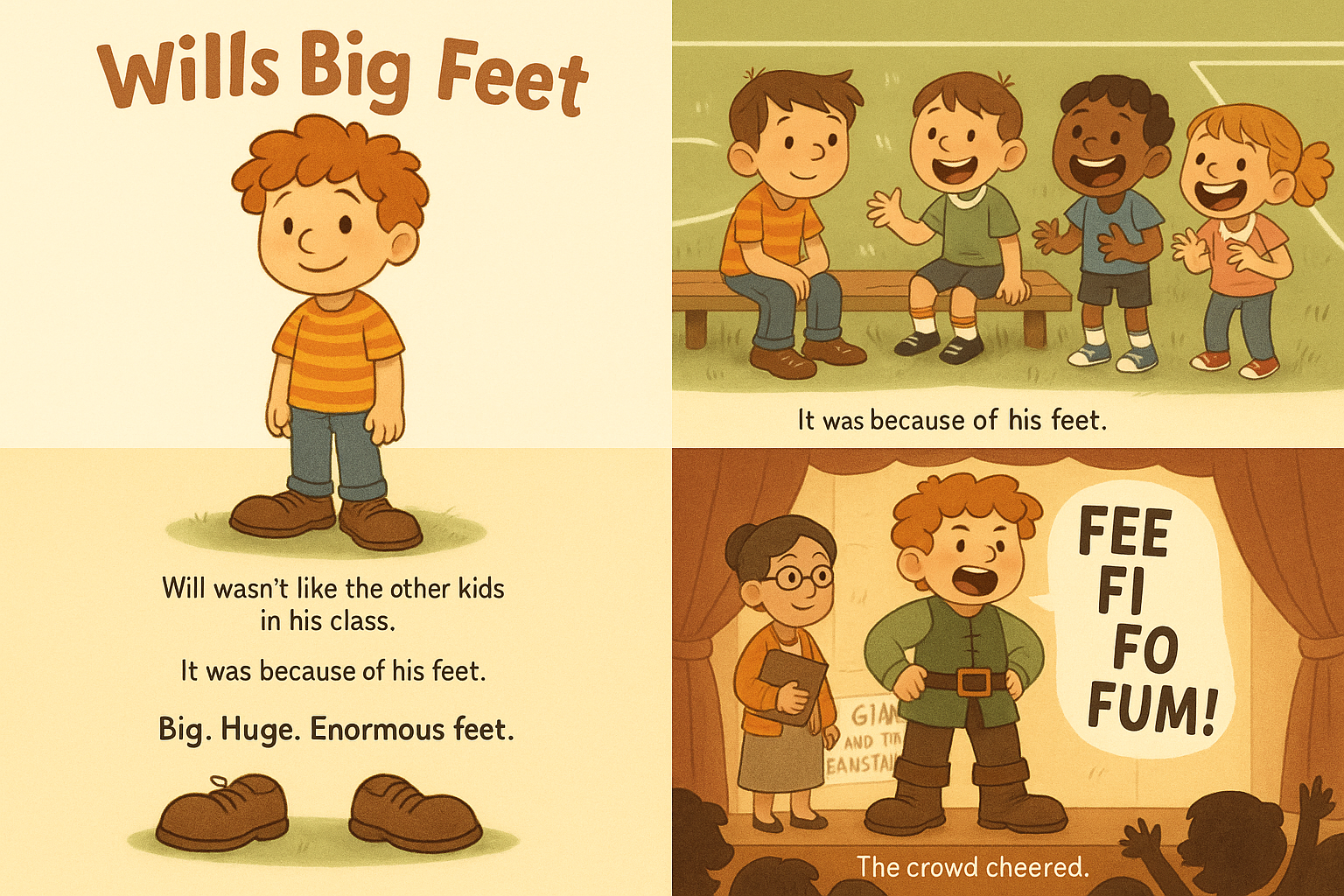
Will wasn’t like the other kids in his class.
It wasn’t because he had wild curly hair.
Or because he could spell “hippopotamus” in kindergarten.
It was because of his feet.
Big.
Huge.
Enormous feet.
Will’s feet were so big, he tripped over them during soccer, kicked off his shoes during sprints, and once popped a balloon by accident just by stepping on it.
Other kids noticed.
“Hey Bigfoot!” someone called once.
“Why are your shoes the size of boats?” another teased.
Will just shrugged. But inside, he wished his feet were smaller.
Normal. Like everyone else’s.
One day, the school announced a play:
“The Giant and the Magic Beanstalk.”
Will rolled his eyes. “Of course there’s a GIANT,” he muttered.
But when auditions came, something surprising happened.
“Will,” said Mrs. Lockett, the drama teacher, “you’d be perfect for the Giant!”
Will blinked. “Because I’m tall?”
She smiled. “That too. But mostly… your feet. They’re amazing.”
Will wasn’t so sure. But he said yes.
At rehearsal, his feet stomped with mighty thuds.
He roared like a giant and wore boots so big the younger kids gasped.
Opening night came.
Will marched on stage, his giant boots booming, and shouted,
“FEE FI FO FUM!”
The crowd cheered.
After the show, kids crowded him.
“Those feet were awesome!”
“You made the best giant EVER!”
“Can I try on your boot?”
Will smiled. For the first time, he didn’t feel weird.
He felt… proud.
From that day on, Will didn’t hide his feet.
He owned them.
He even started a comic called Captain Bigfoot.
Because sometimes, the thing that makes you different
is the very thing that makes you great.
Chapter 10 of 42
The Mum with Magical Hugs
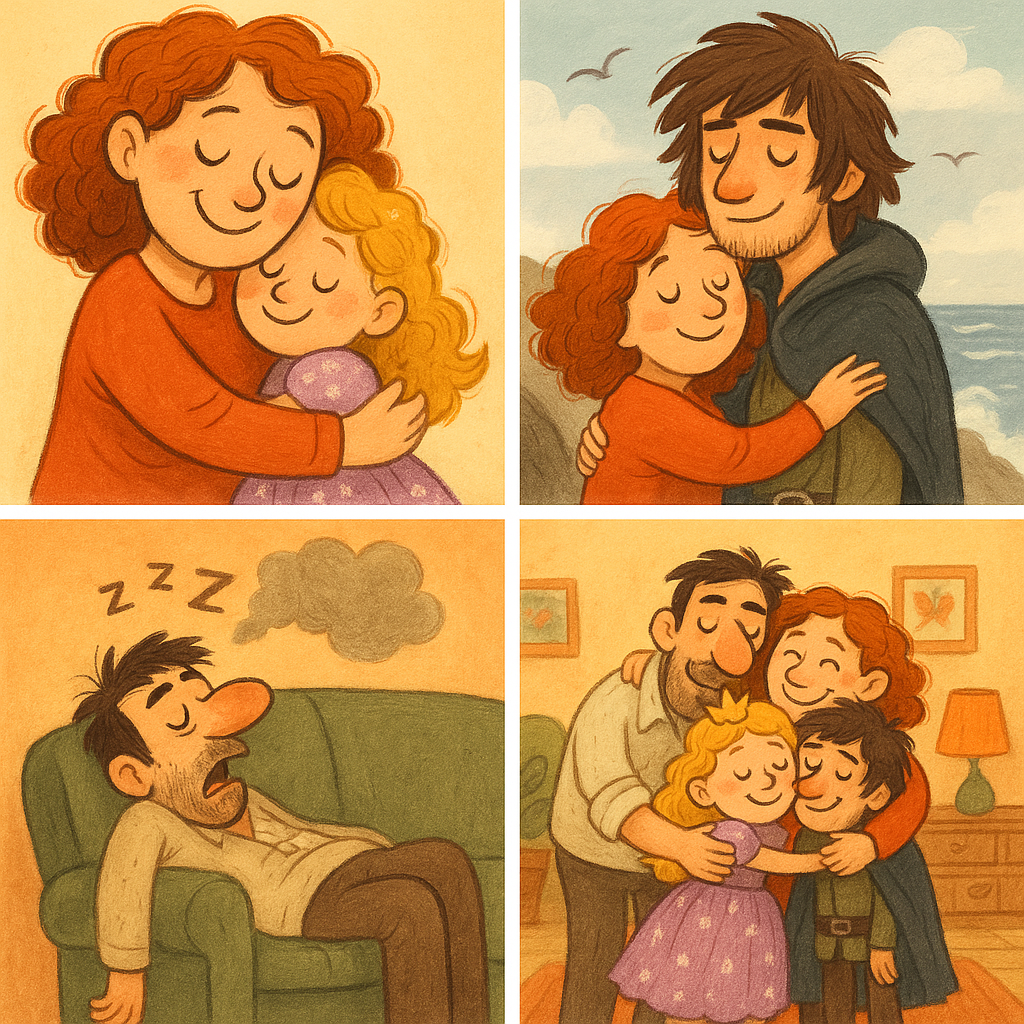
Starring Liz, Princess Grace, Old Stinker, and Will of the Coast
There once lived a mum named Liz who had magical hugs.
Not the ordinary, pat-on-the-back kind.
Nope. Her hugs were warm like a blanket fresh out of the dryer…
and strong enough to chase away grumpiness, gloom, and even stubbed-toe tears.
She lived in a cozy house with her husband, Old Stinker—a farting, snoring, lovable rascal—
their sparkly daughter, Princess Grace,
and her brave and broody stepson, Will of the Coast.
Grace was a whirlwind of glitter, giggles, and questions.
Will mostly sulked on cliffs and stared at seagulls.
Old Stinker? He just tried not to accidentally clear the room.
But when someone got sad…
When Princess Grace scraped her knee,
or Will of the Coast missed his mum,
or Old Stinker had one of those days where even coffee didn’t help…
Liz would step in.
Arms open.
Smile soft.
And she’d hug them.
Zap.
Just like that, the world felt okay again.
Even the cranky cat from next door would sneak in for a cuddle when no one was looking.
One day, Princess Grace declared,
“Mum! You’re not just Mum. You’re a Healing Hug Witch Queen!”
Will of the Coast scoffed, “Pfft. Not real magic.”
But the next morning, when he woke up moody and grey…
Liz pulled him in, gave him a long, tight squeeze—
and Will found himself humming by lunchtime.
From then on, no matter what happened—
lost homework, stubbed toes, bad dreams, or stormy skies— everyone knew what to do:
Find Mum.
Get hugged.
Feel better.
And so, in a little house that smelled faintly of soup, lavender, and Old Stinker’s socks, the magical hugs of Mum Liz kept the kingdom cozy, the princess giggling, the moody boy grounded, and even the old fart smiling.
Chapter 11 of 42
The Sleep Song
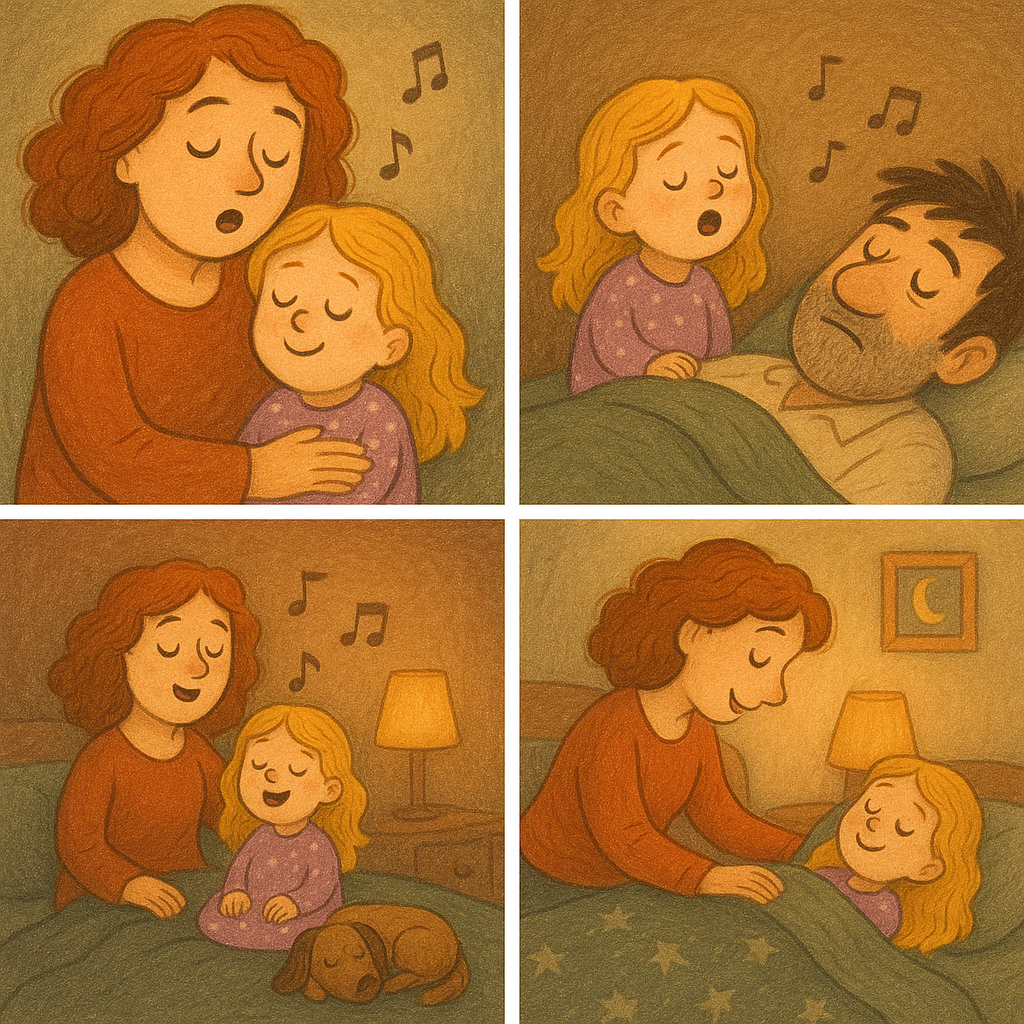
Starring Liz Browne and her daughter Grace
There once lived a woman named Liz Browne,
who had a secret power passed down through dreams.
She could sing people to sleep.
Not just tired people.
Anyone.
Babies with colic?
Out like a light.
Grumpy uncles?
Snoring in minutes.
Even the cranky mailman once fell asleep on her porch!
Her voice was soft like clouds and warm like a hug.
And when she sang, time slowed.
The world exhaled.
And sleep came gently, like feathers falling.
But Liz wasn’t the only one.
Her daughter, Grace, had the gift too.
It started one night when Liz was too tired to sing.
Grace, only three, climbed onto the bed and hummed a tiny tune.
Daddy was snoring before she reached the second verse.
“You’ve got it too,” Liz whispered with a smile.
From that night on, they sang together.
Soft lullabies for their dog,
melodies for restless cousins,
tunes for stormy nights and tired minds.
One time, they sang an entire birthday party to sleep.
Oops.
Another time, Grace hummed in the grocery store and three shoppers nodded off by the bananas.
So they learned to use their powers wisely.
Only for good.
Only when needed.
They became known as the Sleep Singers.
People would call:
“My baby won’t sleep!”
“My husband’s too wired!”
“My brain won’t stop spinning!”
Liz and Grace would arrive quietly.
Sit on the edge of the bed.
And hum their gentle, magical tunes…
Within minutes—
peace.
At home, each night ended the same:
Liz would tuck Grace in,
Grace would yawn,
and together they’d sing each other to sleep,
until the house was still
and the stars blinked down
on two soft voices fading into dreams.
Chapter 12 of 42
The Lost Nugget of Cursby Hollow
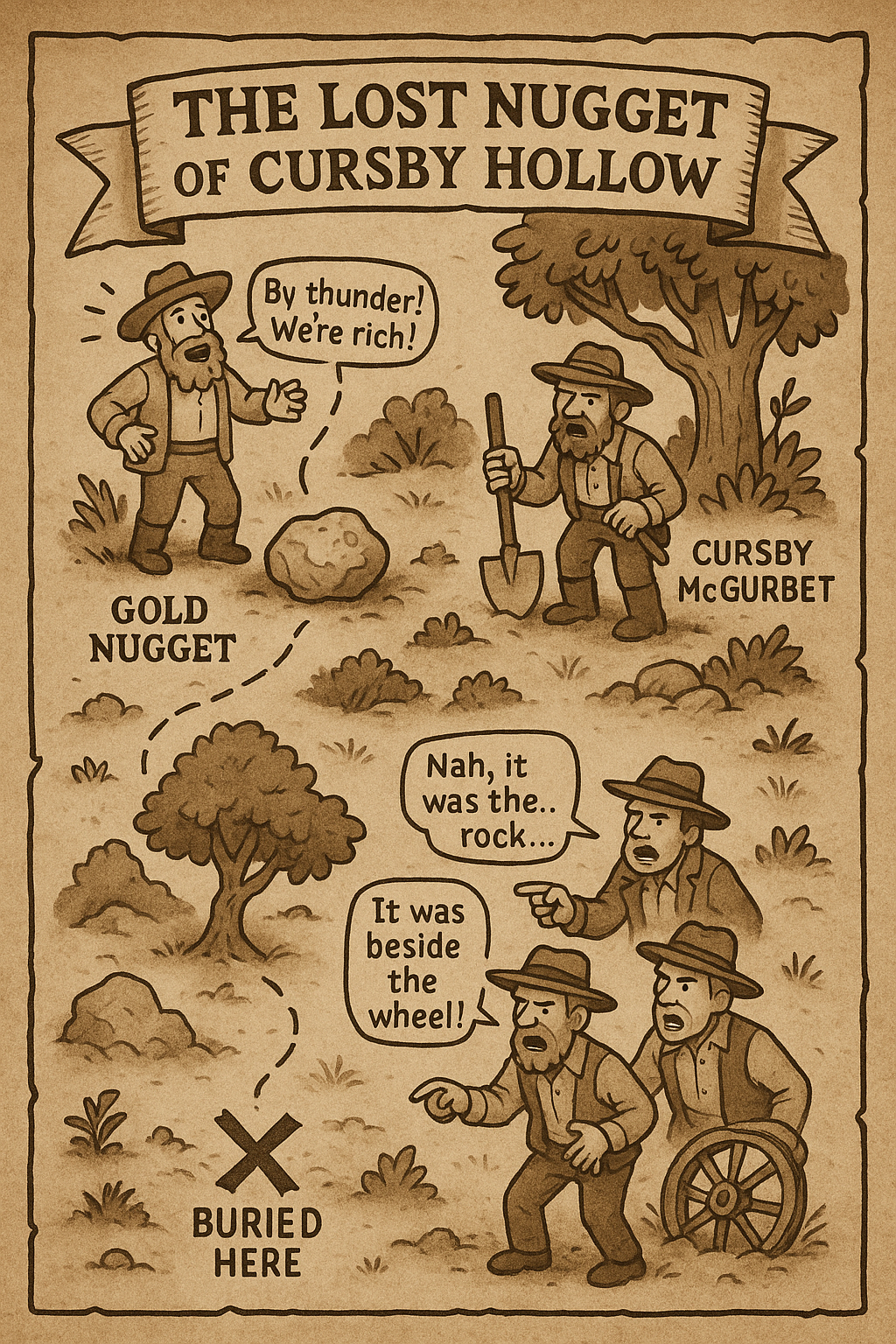
Long ago in the dusty hills outside Cursby Hollow, three mates stumbled upon the find of a lifetime—a gold nugget the size of a potato, lumpy and bright as the midday sun. Its shine was so intense that Choosley Andrews nearly fainted on the spot.
“By thunder!” cried Thursday Dropper, falling backward into a gully. “We’re rich! We’re made!”
But Cursby McGurbet, the oldest and most suspicious of the trio, squinted and muttered, “Ain’t no riches stay rich if someone sees ‘em. We bury it till we sort things out.”
They agreed. Under a crescent moon, they crept to the woods with shovels, a busted compass, and a half-drunk bottle of corn liquor. They chose a spot near a rock that looked like a goat’s arse, dug a hole, dropped the nugget in, and covered it with dirt and bad directions.
To seal the pact, they took a solemn oath:
“None shall dig till all three be ready again.”
Then they celebrated. And drank. Heavily.
By sunrise, nobody could quite remember where the goat-arse rock had been. Or what the exact oath even was.
For years afterward, Cursby, Thursday, and Choosley returned to the woods, arguing.
“This was the tree with the split!” said Choosley.
“Nah, it was the rock that looked like a sleeping cow,” said Thursday.
“It was beside that old rusted wagon wheel,” insisted Cursby—except the wagon wheel had rolled off a cliff in ‘98.
The friendship frayed. They each started digging solo at night, suspicious of the others. Cursby dug up a snake pit. Thursday hit a sewage pipe. Choosley, in a stroke of cruel irony, found an actual gold nugget once—but it was fool’s gold, and he’s never lived it down.
Now they’re old men, still wandering the woods, waving sticks like dowsers and bickering like broken cuckoo clocks. Some say the nugget’s still out there. Others say they never found one at all.
But if you ever go walking near Cursby Hollow and you see three grumpy old men arguing over a rock shaped like a goat’s backside…
…don’t get involved.
They’ll just make you dig.
Chapter 13 of 42
The Boy Who Read Everything
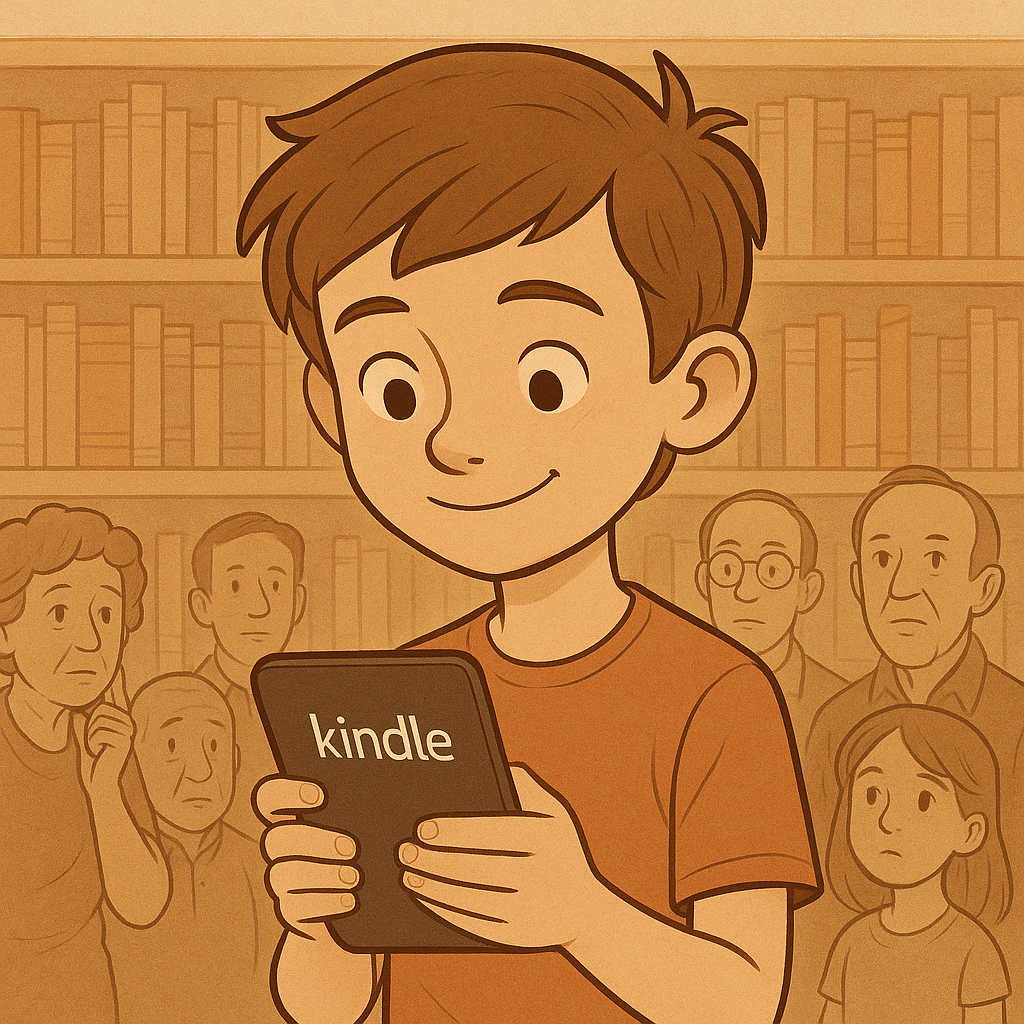
There once was a boy named Felix who, one rainy afternoon, finished the last unread book in his house. He closed the back cover with a satisfied sigh, looked around the room stacked with dog-eared novels and encyclopedias, and said, “Well, that’s that.”
It wasn’t.
The next day, he biked to the local library and borrowed the limit—twenty books. He devoured them in three days. The librarians, both concerned and amazed, gave him a special card that let him borrow unlimited books. Within two months, Felix had read every single book in the building, from the moldy almanacs to the children’s pop-ups.
Still not satisfied, Felix used his birthday money to buy a Kindle. From then on, he read 14 books a day—nonfiction, fiction, sci-fi, cookbooks, poetry, physics, obscure government reports, and old diaries digitized by mistake.
He read while eating. He read while walking. He even read while brushing his teeth, one eye on the screen, the other half-closed in foam.
Soon, strange things began to happen.
His little sister asked him how to build a treehouse. He quoted three architecture guides and an ancient Roman treatise on outdoor structures.
His neighbor asked if cats could dream. Felix rattled off results from twelve feline sleep studies.
Then word got out.
First, the local news ran a story: “Boy Reads Everything, Has Answers.”
Then a podcast flew in to interview him. Then a scientist. Then a monk. Then a man from Sweden who had questions about dolphins and time travel.
People lined up outside his house with notebooks, confused faces, and existential dilemmas. Felix answered them all with calm, precise clarity—except once, when someone asked how to fall in love. He blinked, thought, and said, “You’ll probably want to talk to someone else about that.”
But he read about it that night, just in case.
Eventually, universities offered him honorary degrees, countries offered him citizenship, and one eccentric billionaire offered him a solid-gold Kindle. He declined them all, saying, “I still have books to read.”
And so, Felix kept reading—under trees, in crowded parks, on rooftops, in boats, at weddings (rude), and even while getting a haircut (awkward).
People kept coming. And every time someone asked, “How do you know that?” he’d simply smile and say:
“I probably read it somewhere.”
Chapter 14 of 42
The Day Dad Smiled Again
Before the hospital, Dad was loud.
He laughed too hard at cartoons. He made pancakes shaped like dinosaurs. He danced in the kitchen to songs that didn’t even have words.
But then he got sick. Not a cough or a fever kind of sick. A quiet kind.
He went away for a little while. I stayed with Grandma. When he came home, he was… still quiet. Not the good kind. The heavy kind. Like something was sitting on his chest and he couldn’t laugh without lifting it.
The doctor had told him to start meditating.
“It might help the mind settle,” she’d said. “Five minutes a day to begin with.”
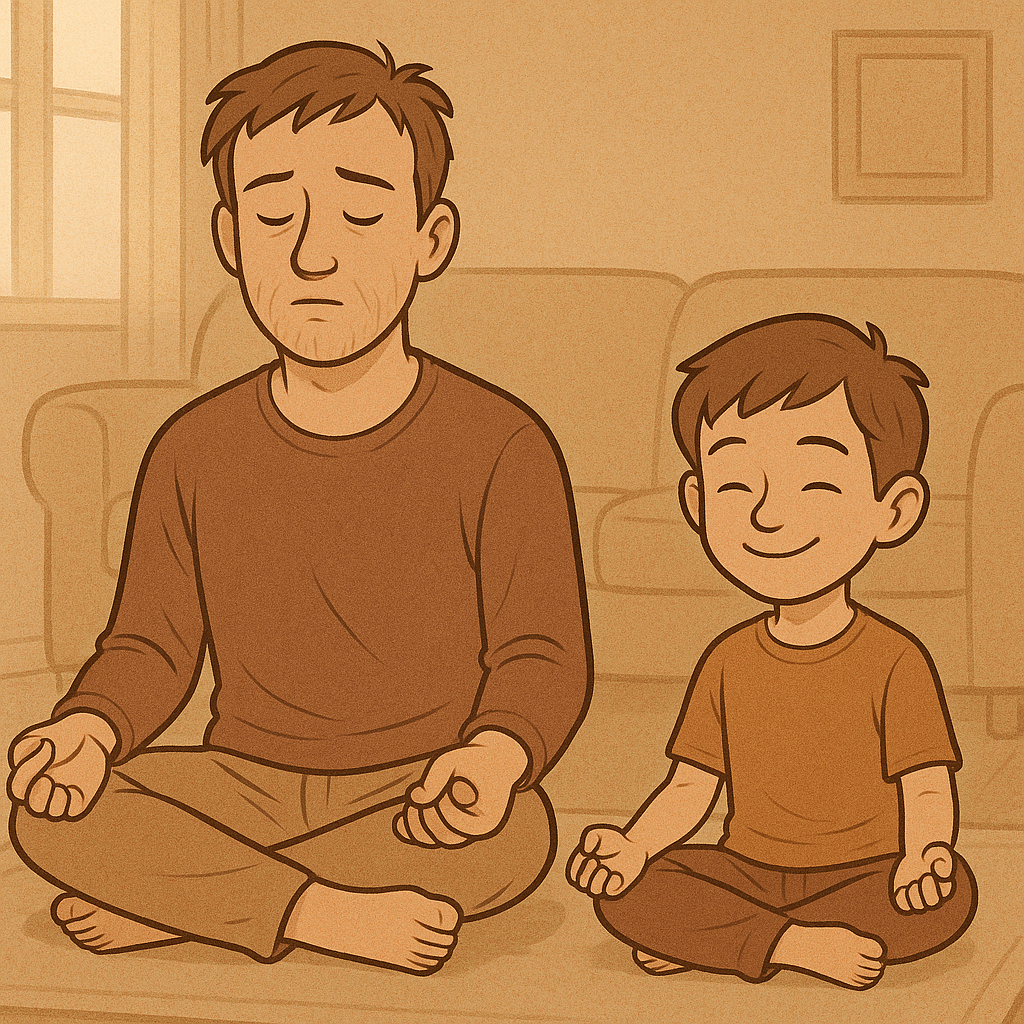
So Dad started sitting on the floor, eyes closed, legs crossed, hands on his knees. I didn’t really get it. He didn’t hum or say “ohm” like in cartoons. He just breathed. And sat. And sometimes cried without noise.
He didn’t play much anymore. He forgot the pancake dinosaurs. The TV stayed off. He watched the wind out the window a lot, but not the kind of watching where you see things. The kind where your eyes are open but your heart’s somewhere else.
I missed him.
One morning, I found him in the lounge, sitting like a statue. The sun came through the window and made a pattern on his face. He looked like a man-shaped puzzle someone hadn’t finished putting back together.
I didn’t know what to say. So I sat beside him. Quiet. Like he was.
I crossed my legs. Put my hands on my knees. Tried breathing slow like he did.
I didn’t really know how to meditate. But I figured maybe sitting still beside someone who’s sad is a kind of medicine too.
We sat there for a long time. Or maybe not long at all. Time feels funny when you’re quiet.
Then, something happened.
Dad opened one eye. Looked at me. And smiled.
It was small. But it was real. The first one since he came home.
He didn’t say anything, and neither did I.
But that smile said:
Thanks for sitting with me.
I’m still here.
I think I’ll be okay.
And maybe he would be.
Because now, he didn’t have to be quiet alone.
Chapter 15 of 42
The Space Between Them
There once was a dad named Matt, who loved his son Jamie more than anything in the world—but he showed it the wrong way.
He pushed too hard.
“Try harder.”
“Don’t cry.”
“That’s not good enough.”
He thought he was helping Jamie become strong. But what Jamie felt was that he was never enough.
Jamie’s mum, Ella, tried to soften things. She reminded Matt to be gentle, to listen, to see their son. But Matt’s idea of love was full of rules and raised eyebrows, and little by little, Jamie stopped smiling around him.
One day, Ella packed up the car.
“We need some space,” she said softly.
Jamie didn’t look back.
Matt sat in the quiet house that night and stared at the wall where Jamie’s drawings used to hang. He cried for the first time in years—not the frustrated kind of tears, but the aching ones, the kind that spill when you realize you were wrong.
He wrote letters. He didn’t send them. Then he did.
The first one just said:
“I miss you. I’m sorry. I didn’t know how to be the dad you needed. I’m trying to learn. I love you.”
Jamie didn’t reply at first. But he read them all. Every single letter.
Matt started therapy. Started listening more than talking. Started volunteering at Jamie’s old school. He read books on parenting, kindness, forgiveness—even ones with corny titles he would’ve once laughed at.
Then, one weekend, Ella agreed to bring Jamie for a short visit.
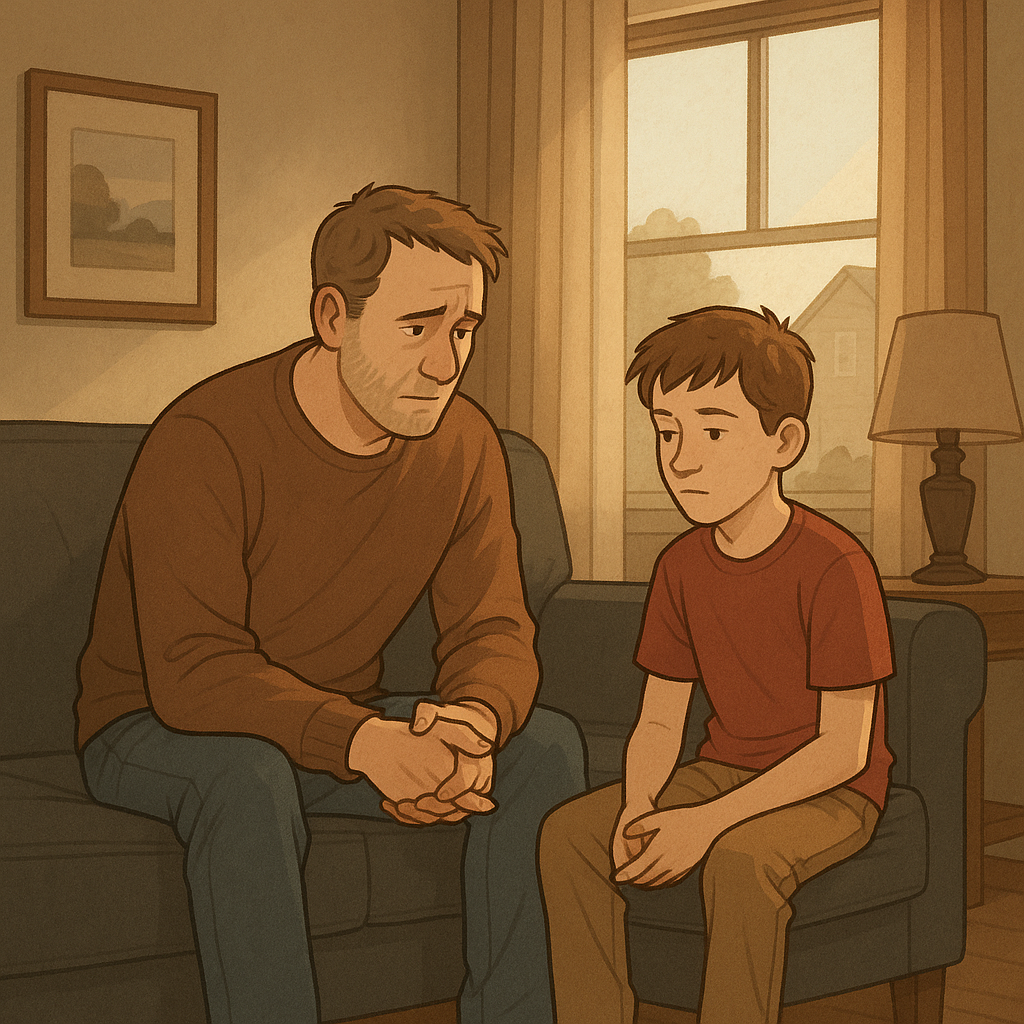
Jamie stood at the doorway, taller than Matt remembered, with guarded eyes and a familiar silence. But Matt didn’t rush. Didn’t lecture. Didn’t try to fix everything in a day.
He just said, “Hi, Jamie. I’m really glad to see you.”
They went for a walk. Talked about safe things at first—school, movies, a dog Jamie liked. Matt didn’t try to steer the conversation. He just listened. Really listened.
Over months, the visits got longer. They built a shelf together. Played video games. Watched old cartoons. Jamie even laughed once, and Matt nearly cried again—but held it in.
One night, as Jamie got into bed, he said, “You’re… different now.”
Matt nodded. “I had to be. I didn’t want to lose you.”
Jamie looked at him, quiet for a moment.
“I think I’m starting to like being around you again,” he said.
Matt smiled, not too big, not too fast. Just enough.
And from that moment, father and son began to stitch the torn pieces between them—thread by thread—until the space that once kept them apart became the space they chose to share.
Chapter 16 of 42
The Sad Queen and the Child Named Grace
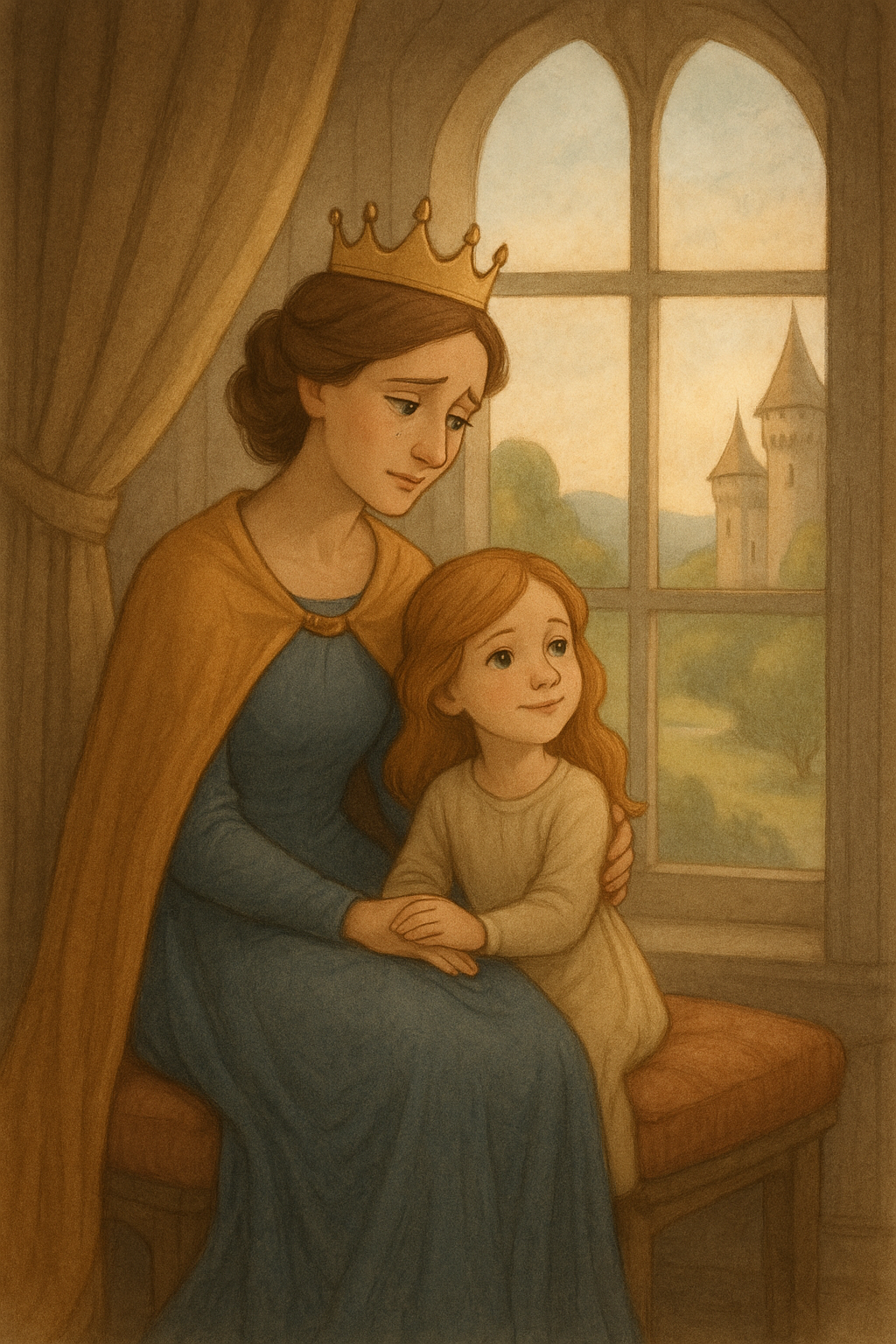
In a kingdom nestled between the whispering forests and the singing rivers, there lived a queen who was beloved by all. Her name was Queen Elenora, though most simply called her The Gentle Queen.
She ruled with a soft voice and an open hand. She gave warm bread to the hungry, stitched cloaks for orphans in the winter, and visited the sick even when the weather turned cruel. Her kindness was like sunlight—steady, golden, and nourishing.
But inside her heart, a quiet sadness lived.
No one knew why it came. Some said it was because her husband, the king, had vanished at sea long ago. Others said the weight of caring for everyone left no room to care for herself. Whatever the reason, sometimes the queen would retreat to her chambers, sit by the window, and cry without a sound.
The kingdom still loved her. They sent her letters, songs, flowers. But even all their love couldn’t chase the sadness away completely.
Then one day, Queen Elenora had a child.
A little girl with laughing eyes and a spirit that danced like candlelight. Her name was Grace.
And Grace changed everything.
When the queen grew quiet, Grace would climb onto her lap, wrap her small arms around her mother’s neck, and whisper, “It’s okay to be sad, Mummy. I’m here.”
When the queen forgot to eat, Grace would bring her a plate and insist they have a “picnic in bed.”
When the queen stared too long at the clouds, Grace would tug her hand and say, “Come see what I made!”—a finger-painted dragon, a daisy crown, a lopsided cake full of joy.
Grace didn’t try to fix her mother. She simply loved her.
And slowly, something shifted.
The queen still had sad days. But now, they were shared.
The castle halls began to echo not just with royal steps and solemn duties—but with laughter, pillow forts, midnight stories, and songs made up on the spot.
People noticed the change.
“The queen seems lighter,” they said.
“She smiles more,” said the baker.
“She hums,” said the stable boy.
They didn’t know the reason.
But in truth, it was because a little girl named Grace had given the queen what she had always given to others:
Gentleness.
Understanding.
And love without asking for anything back.
From that day on, the kingdom began to call her something new.
Not just The Gentle Queen.
But The Mother of Grace.
Chapter 17 of 42
The Cheeky Princess
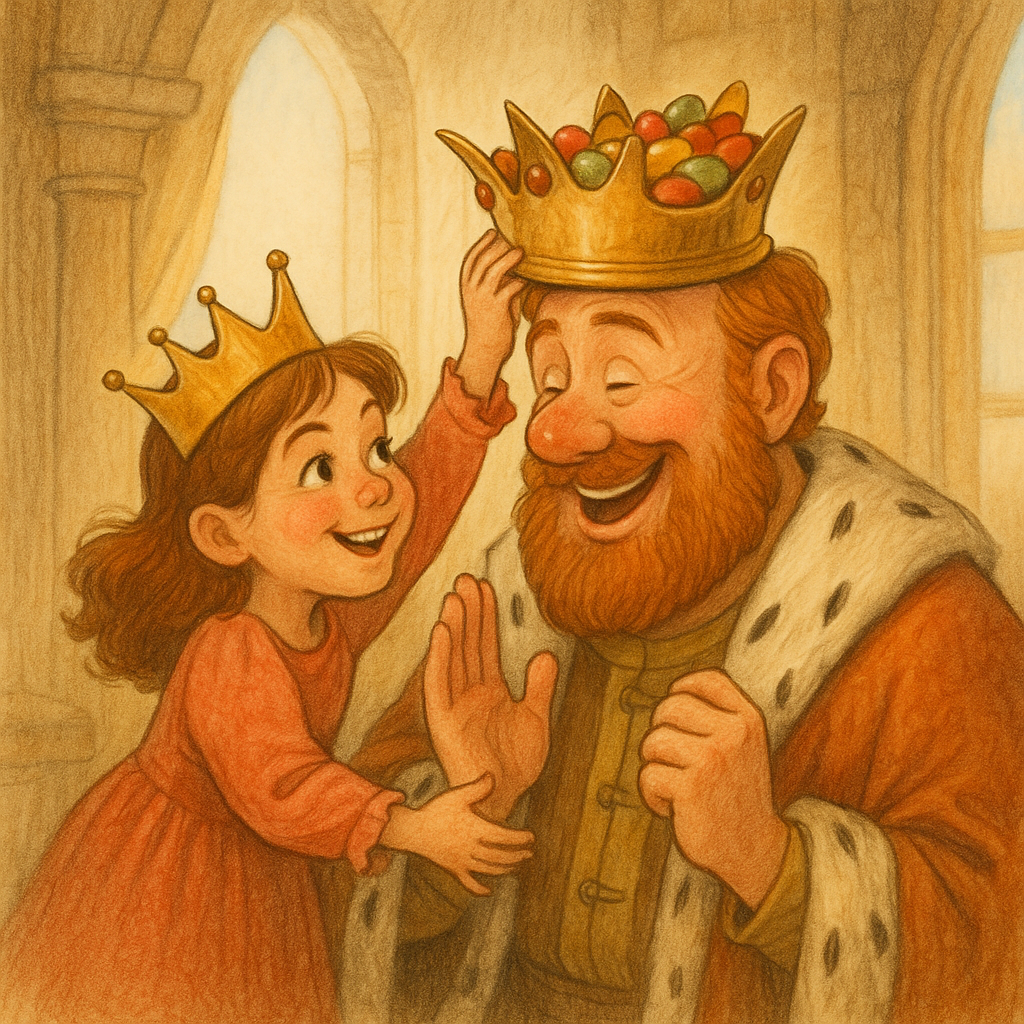
In the grand kingdom of Tumbledown, where the castle turrets looked like whipped cream and the guards sometimes wore mismatched socks (because the princess told them it was royal fashion), there lived a girl named Grace.
She was the princess.
But not just any princess.
She was the Cheeky Princess.
Everyone in the kingdom adored her. She was sweet and kind and full of giggles. But she was also a whirlwind of trickery, especially when it came to one person: her silly dad—the king.
Now, the king loved Grace more than his golden throne, his royal socks, or even his extra-large jelly trifle (which is saying something).
But oh, she got him good.
One day, she painted googly eyes on every royal portrait. So everywhere the king went, people seemed to stare at him with very wobbly intentions.
Another day, she filled his crown with jelly beans. He wore it to a very serious meeting and didn’t notice until three bounced out mid-speech.
He blamed the court wizard. The court wizard blamed gravity.
Then there was the time she trained the royal parrot to say, “Who’s the silliest sausage in the land? YOU ARE!” whenever the king walked past.
The king huffed. He puffed. But he never truly got mad. How could he? Every prank ended in Grace throwing her arms around him and saying, “I love you, Daddy.”
And the truth was… he was a bit of a silly sausage.
One night, after she put syrup in his slippers, he tucked her into bed and asked, “Why do you always trick me, my cheeky little tornado?”
Grace blinked innocently. “Because you always laugh, Daddy. And because your laugh is the funniest sound in the whole wide world.”
The king chuckled. Then snorted. Then really laughed.
And from then on, he made a secret vow:
To prank her back.
The next morning, she opened her wardrobe and found it stuffed full of balloons.
On each one, written in big letters, was:
“Gotcha, Princess.”
From then on, the kingdom of Tumbledown had a new royal tradition:
The Great Prank War between the Silly King and the Cheeky Princess.
And it never, ever got old.
Chapter 18 of 42
The Boy Chef
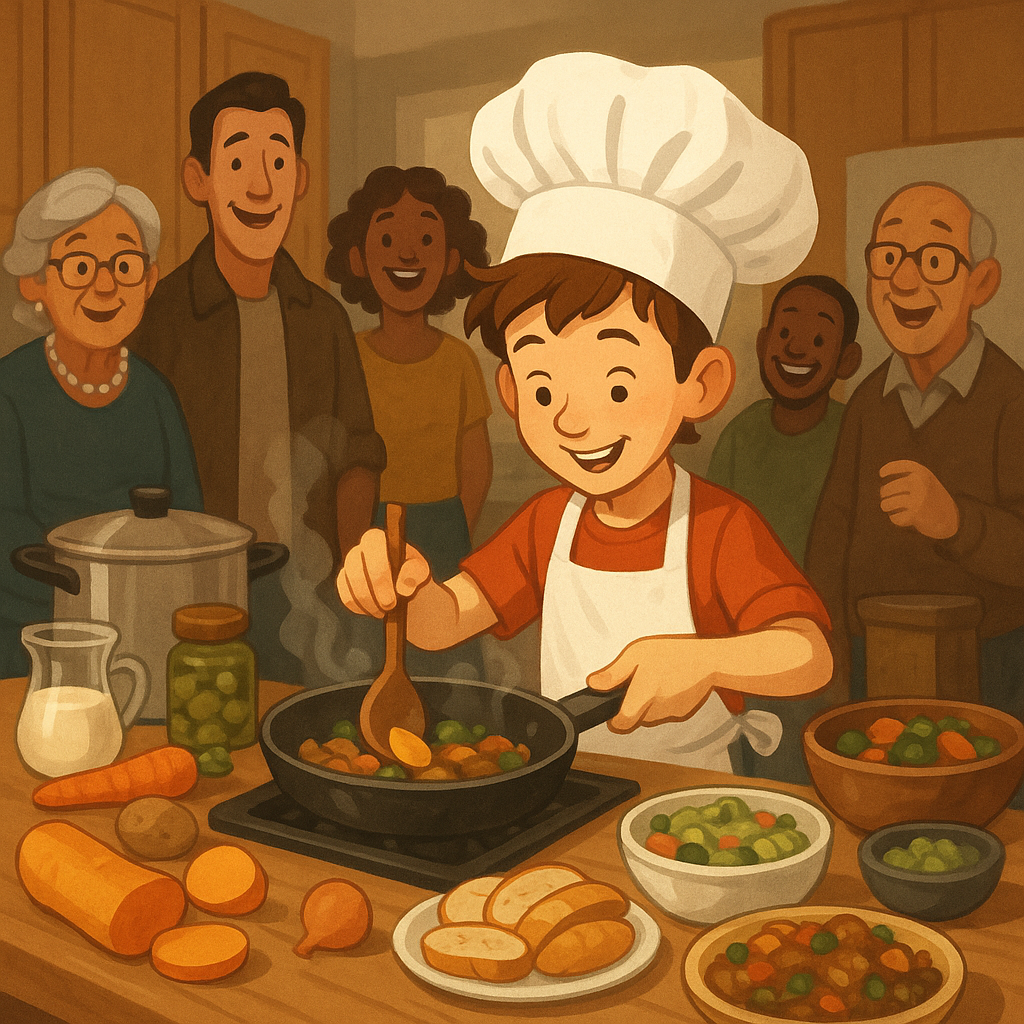
In a cozy town where the houses smelled like bread and the wind carried hints of cinnamon, there lived a boy named Will.
Will was no ordinary kid. He didn’t care much for soccer or video games. He didn’t even like cartoons all that much.
But show him a fridge full of leftovers, and he lit up like a Christmas tree.
While other kids asked for pizza or nuggets, Will asked, “What’s in the back of the fridge?” He loved the mystery of it. A half-used jar of olives? Yes, please. Three spoons of mashed potato? Perfection. That lone zucchini nobody remembered buying? Even better.
His mum used to joke, “If it’s edible, Will will make it incredible.”
And it was true.
One day, when the power went out in the whole neighborhood, every fridge started to warm. People panicked. Ice cream melted. Yogurt cried. Sausages sighed.
But Will had a plan.
He rolled up his sleeves, tied a tea towel around his waist like a chef’s apron, and got to work.
From the leftover lasagna noodles and half a carrot, he made crispy lasagna bites.
From three eggs, a squishy banana, and a heel of stale bread, he whipped up golden French toast with caramelized banana drizzle.
He even made a weirdly amazing stew out of lentils, pineapple juice, and peanut butter. People were suspicious… until they tasted it. Then they begged for more.
Soon the neighbors were knocking on the door.
“We’ve got an onion and some feta!”
“We found a lemon and two spring rolls!”
Will welcomed all. “Let’s see what we can do.”
By sunset, the whole street smelled like a five-star restaurant. Will stood proudly behind a makeshift counter, handing out plates with a grin.
People cheered. They called him The Boy Chef.
Someone said, “He’s like a magician, but with mayonnaise.”
Will just shrugged and said, “I don’t do magic. I just do food.”
From that day on, whenever someone didn’t know what to cook, they didn’t Google it.
They went to Will.
Because Will believed that with a little love, a dash of bravery, and whatever you had in the fridge…
Anything could be a feast.
Chapter 19 of 42
Old Stinker and the Kids Next Door
Everyone on Peppercorn Lane knew the old man in the leaning house with the rusted gate. They called him Old Stinker. No one really knew his real name. He growled at dogs, glared at mailboxes, and once chased a birthday balloon for trespassing.
His front yard was full of weeds, his eyebrows were full of opinions, and his mouth was full of grumbles.
Then one spring morning, a moving truck pulled up next door. Out came a family: a mum with a warm smile, a dad who waved too much, and two kids—Will and Grace.
Grace was six and believed everyone was a friend she hadn’t met yet. Will was nine and believed no mystery was unsolvable, including the mystery of Old Stinker.
“Why does he stink?” Grace asked.
“Maybe he’s just sad,” Will said. “Or maybe he hasn’t smiled since 1972.”
The first thing they did was bring him cookies. He didn’t answer the door. So they left them in a neat little stack on the doormat with a note:
“From your new neighbors, Will and Grace :)”
The cookies were gone the next morning. The plate was returned three days later, scrubbed clean.
Then Will invited him to a paper plane contest. No answer.
Grace drew a chalk rainbow on his driveway. He hosed it off—but the next day, he drew a single star in chalk himself.
It went like that for weeks. Will asked him to help fix his go-kart. Stinker fixed it better than new, then grumbled, “It’s not because I like you.”
Grace brought him a flower crown. He grunted, wore it for five seconds, then swore the sun made his head itchy.
But one day, the kids found Old Stinker sitting on his porch, staring at the sky.
“You want to come build a fort?” Will asked.
Old Stinker shrugged. “Only if I get the top bunk.”
And that’s when everything changed.
Old Stinker started waving—awkwardly, but still. He let Grace plant sunflowers in his front yard. He taught Will how to whittle wood. He even started going by his real name again—Mr. Arnold—but most people still called him Old Stinker, only now with a grin.
And every time someone asked what happened to the grump in the leaning house, folks just pointed next door and said:
“Will and Grace happened.”
Chapter 20 of 42
Dad’s One Dish
Most nights, dinner at our place was a bit of a gamble.
Sometimes the spaghetti crunched like gravel. Sometimes the chicken was still doing laps. Once, Dad proudly served us something he called “Casserole Surprise”—the surprise being it was just canned beans and cornflakes.
But there was one dish. One glorious, unstoppable dish.
Noodles with plum sauce.
It was the only thing Dad ever got right.
He didn’t make the noodles from scratch or anything—just packet stuff from the bottom shelf. The plum sauce? A sticky bottle from the back of the fridge with a cracked label and probably too much sugar. But somehow, when he tossed them together in his battered old wok, magic happened.
He’d plate it with flair, grin like a kid, and say, “Plum noodles, coming at ya!”
I’d eat every bite.
Then ask for more.
I think he liked that. I think maybe, when everything else felt a little off-kilter—burnt toast mornings, failed roast nights, forgotten birthdays—he liked knowing he could make one thing his son actually loved.
He made plum noodles three times a week, sometimes four. I never complained. Not once. Because it wasn’t really about the noodles. It was about him trying.
And sometimes trying tastes better than perfect.
Even now, I can’t eat plum sauce without smiling.
Chapter 21 of 42
Will and the Whopper
Every Saturday morning, rain or shine, Will would hop into Pop’s rusty ute, fishing rod in hand and toast in his mouth.
“Got a good feeling today, Pop,” he’d say every time, whether they caught anything or not.
Pop would just chuckle. “That’s what you said last week when we caught that gumboot.”
They always went to the same spot—an old wooden jetty on the edge of Willow Creek, with water so still it looked like glass. Pop would cast his line in with slow, practiced rhythm, while Will went wild, trying new lures, new spots, even talking to the fish sometimes.
Then came The Saturday.
The sky was golden, the water thick with mist, and Will had just finished telling Pop, “Today’s the day, I can feel it in my thumbs.”
He cast his line. Waited. Then bam—his rod bent like it was trying to fold in half.
“Pop! It’s a big one! A real big one!”
Pop dropped his thermos. “Hold steady, Will!”
Will gritted his teeth. The reel screamed. Whatever was on the other end wasn’t giving up easy. Five whole minutes of pulling, wobbling, shouting, and nearly falling in—until finally, thrashing and shining in the sunlight, the fish surfaced.
It was a carp the size of a border collie.
“Sweet mercy,” Pop breathed. “That’s not a fish. That’s a submarine.”
They took a photo next to it, both holding it up like a trophy. By Monday morning, the paper came out:
“LOCAL LAD CATCHES MONSTER CARP”
11-year-old Will Stanton and his Pop reel in whopper from Willow Creek.
The photo was right there on the front page, under the headline, with Will’s grin stretching wider than the creek itself.
From then on, everyone in town knew Will and Pop as “the fish boys.” And every Saturday, even after the fame faded, they still went out to Willow Creek. Same jetty. Same toast.
Only now, Pop would say, “Got a good feeling today, Will.”
And Will would wink. “Yeah, but not as good as that day.”
Chapter 22 of 42
Grace and the Painted Door
Grace loved to draw.
From the moment she could hold a crayon, she was sketching on napkins, notebooks, even her bedroom wall (which her mum was not thrilled about). She painted skies with green suns and oceans full of floating cupcakes. Every birthday, she asked for new pencils, watercolours, and canvases instead of toys.
As she got older, Grace never stopped. While other kids were out on bikes or glued to their phones, she’d be in her room, smudging pastels or dabbing paint, music humming in the background. She didn’t care if anyone liked her art. She just had to make it.
She practiced every single day.
Her drawings got sharper. Her colours deeper. Her imagination wilder. At sixteen, she could paint eyes that looked like they knew you. Trees that seemed to sway if you stared long enough. People started to take notice.
Then, one quiet evening, something strange happened.
She was working on a canvas—just messing around, layering a field of tall yellow grass with a crooked old wooden door in the middle. The kind of thing she’d dreamt up a thousand times.
She stepped back to look at it… and the door on the canvas shimmered. Just for a second.
She blinked. Took a step closer. The brush dropped from her hand.
The painted door was open.
On the canvas, behind the door, was a flickering light. And then—Grace could feel warm air coming from it. Smell lavender. Hear wind chimes.
Her heart thundered.
She reached out and touched the doorframe, half-laughing, half-scared.
And just like that—whoosh—she was pulled in.
The world inside the painting was breathtaking. Floating lanterns. Talking animals. Mountains that glowed at night. Everywhere she looked was like something she’d painted before—but alive. Real.
A fox in a waistcoat greeted her. “You’ve finally come. The Artist.”
She spent what felt like days wandering, learning, sketching the magic she saw. But when she stepped back through the painted door, only five minutes had passed.
From that day on, Grace knew: the better she got at painting, the deeper she could travel. Each new canvas could become a doorway. And every masterpiece held a world waiting to be discovered.
So she painted.
Every single day.
Because when your art becomes magic—why would you ever stop?
Chapter 23 of 42
Elizabeth, Unmuted
Elizabeth was the girl who never said no.
If you needed a favour, she’d say yes. If you were angry, she’d apologise—even if it wasn’t her fault. If the group wanted pizza and she wanted sushi, she’d smile and say, “Pizza sounds great!”
People called her sweet.
Teachers said she was well-behaved.
Her mum said she was easy.
But Elizabeth?
Elizabeth felt invisible.
She didn’t know when it started—maybe when she was little and figured out that being agreeable got her approval. Maybe when friends drifted away after she stood up for herself once. Maybe it was just easier to be what people wanted.
Until one day, something inside her snapped.
It wasn’t dramatic. No yelling. No flipping tables.
Just a quiet moment in the school cafeteria, when someone asked, “You’re okay with skipping the movie and going to that loud party instead, right?”
Elizabeth opened her mouth to say, “Yeah, sure.”
But instead, she blinked and said, “Actually… no.”
Three seconds of silence.
A record scratch in her brain.
Then someone laughed awkwardly and said, “Oh… okay.”
That night, Elizabeth lay in bed and whispered out loud:
“What do I like?”
Because she didn’t know.
She’d been pleasing people so long, she’d forgotten herself.
So she went on a quest—not across countries, but across her own mind.
She tried things. Quiet things. Loud things. She took herself on “taste tests of life.”
She painted (badly).
She went hiking (hated it).
She read poetry (loved it).
She learned to make dumplings from a YouTube grandma (delicious).
She danced in her room like a weirdo to 80s music (freedom).
And slowly, she started filling in the blank parts of herself.
She stopped faking laughs.
She said, “No, thank you,” without guilt.
She made real friends who liked her, not the version of her that was always polite and pliable.
One day in class, a boy asked her, “You’ve changed. What happened?”
Elizabeth just smiled. “I stopped being an echo. Started being a voice.”
And that voice?
Was finally hers.
Chapter 24 of 42
When Ricky’s Computer Broke
Ricky was always on the computer.
Emails, forums, editing photos, making weird little apps no one used but him. If you walked past his office, you’d see the glow of the screen lighting up his face like a campfire. Tap-tap-click. All day. Sometimes all night.
His kids would knock on the door. “Dad, wanna play soccer?”
“Soon,” he’d say, eyes still on the monitor.
His wife would bring him tea and kiss his cheek.
“Thanks,” he’d mumble, not looking up.
Even the dog had stopped bothering to beg for walks.
Then one Thursday morning—snap, fizz, dead.
The computer just died.
Wouldn’t turn on.
Wouldn’t beep.
Wouldn’t even sulk like it usually did when it was moody.
Panic.
Mild rage.
Unplug. Replug. Swear softly.
Eventually, he took it to the local repair guy, who said, “Could be a few days.”
A few days?
Ricky didn’t know what to do with his hands.
The first few hours felt like withdrawal. He walked around the house like a confused ghost. Sat on the couch. Stared at the wall. Picked up a book. Put it down.
Then something strange happened.
He heard laughter from the backyard.
He went outside and saw his daughter doing cartwheels on the grass. His son was trying to build a rocket out of cardboard. They looked up.
“Dad! You came outside! Want to help?”
He hesitated. Then…
“Yeah. Okay.”
They built a spaceship that wouldn’t pass any safety checks but looked awesome.
He kicked the soccer ball until his legs ached.
He sat on the porch with his wife and talked about nothing, and it felt like everything.
He took the dog for a walk and noticed how golden the trees looked in late afternoon.
He cooked.
He danced in the kitchen.
He laughed more in two days than he had in months.
By the time the repair guy called to say the computer was fixed, Ricky didn’t rush over.
He still picked it up. Still used it.
But something had changed.
He started closing the lid more often.
Turning it off at dinner.
Leaving the office door open.
Because Ricky realised something simple:
The world inside the screen could wait.
But the one outside—his family, his life—was happening right now.
Chapter 25 of 42
Pop and the Great Shed Lock-In
Pop was fixing a broken rake in the garden shed when the door blew shut behind him with a loud clang.
He reached for the handle.
Locked.
No key.
“Ah, biscuits,” he muttered, rattling the door. “Will? You out there, mate?”
Will, his ten-year-old grandson, poked his head around the corner, chewing a muesli bar. “You stuck, Pop?”
“No, I just live in here now,” Pop grumbled. “Yes, I’m stuck!”
Will tried the door. Locked solid.
“Where’s the key?”
“If I knew that, I wouldn’t be stuck in here, would I?!”
Will thought for a moment, then brightened. “It’s okay! I’ll keep you entertained!”
He ran off and came back with an armful of Mum’s cookbooks.
“Here! I’ll slide these under the door!”
Pop squinted. “What…? Cookbooks?”
Will grinned. “You like reading, right?”
Pop sighed, sitting on an upturned paint bucket. First came ‘101 Soups to Warm the Soul.’ Then ‘Vegetarian Delights of the Southern Coast.’ Then ‘Baking with Buckwheat.’
By the fifth book, Pop had had enough.
Through the crack under the door came Will’s cheerful voice: “This one’s got quinoa muffins, Pop!”
Pop exploded. “Why do I want these for? I can’t cook in here!”
Outside, there was a beat of silence. Then Will started giggling. Then his mum. Then even Pop, grumbling and laughing through his nose.
Eventually, Mum came outside and asked, “Will, where’d you last see the shed key?”
Will blinked. “Uh… maybe… my backpack?”
Sure enough, the key was in a side pocket, wrapped in a tissue and two jellybeans.
They opened the shed door and Pop stepped out, arms crossed, face stern.
“You lot better not expect me to make quinoa muffins after this.”
Will beamed. “What about soup?”
Pop shook his head. “Only if it comes out of a can.”
And from that day on, Pop always checked his own pockets—just in case.
Chapter 26 of 42
The Magical Shard of Sacurard
Long ago, in a land that only ever appeared on maps drawn by dreamers, there was a kingdom named Sacurard. It had no castles, no kings, no armies—just hills that hummed and forests that whispered. At the heart of Sacurard, hidden beneath the roots of an ancient tree, lay a single glowing shard. No one knew where it came from. They only knew it was magic.
Legend said the shard could grant one thing to whoever found it: not a wish, not riches—but exactly what their soul truly needed.
For centuries, people searched. Adventurers dug tunnels. Scholars drew symbols. Thieves tried to trap it. But the shard remained hidden. That is, until a quiet girl named Lila stumbled across it by accident.
She wasn’t searching for power. She wasn’t even sure where Sacurard ended and her backyard began. She was just following a curious bird through the woods when her foot slipped, and she tumbled into a hollow beneath the tree.
There it was.
The shard.
It pulsed with a soft blue light, not cold, not hot. It felt like music and memory and something just out of reach. Lila reached out and touched it.
Suddenly, everything around her went quiet. The trees stopped rustling. Even her heartbeat seemed to pause. And then she heard it—words, but not spoken. They formed directly in her chest:
“What is it that you truly need?”
Lila stood there, confused. She didn’t need gold. She didn’t need fame. But after a long silence, she whispered:
“I think… I need to believe I’m enough.”
The shard flared with warmth.
In that moment, Lila remembered every small brave thing she’d ever done. Every time she’d comforted someone, helped without reward, tried even when she was scared. She saw herself—not perfect, but enough.
The shard dimmed, its gift given. And just like that, it dissolved into dust, floating upward like fireflies.
Lila climbed out of the hollow, feeling the same but somehow different. Lighter.
No one believed her story, of course. But that didn’t matter.
Because the real magic of Sacurard wasn’t in the shard.
It was in what it awoke in the person who touched it.
And somewhere, deep beneath the roots of a different tree, in a different forest, a faint glow began to stir again… waiting for the next soul who needed it most.
Chapter 27 of 42
The Long Wait for Grace Robyn
Ricky and Elizabeth wanted a child more than anything.
They painted the spare room soft yellow. Bought a second-hand rocking chair. Talked in quiet whispers about names and futures and all the tiny socks they’d one day lose in the laundry.
But the months passed.
Then years.
And the nursery stayed empty.
They tried everything—doctors, herbs, hope, heartbreak. They’d sit on the couch in silence some nights, too tired to cry, too stubborn to stop loving each other.
And then one day… they gave up.
Not on each other. Not on life. Just on the idea that this dream had to come true for their story to be whole.
They packed the baby things in boxes. Donated the crib.
And instead, they planted a tree in the backyard.
A crepe myrtle.
Soft pink flowers in spring.
“We’ll grow something,” Ricky said, pressing the soil down.
Elizabeth nodded. “Something beautiful.”
Then, just as they let go of the dream—
Life surprised them.
Elizabeth felt off one morning. Not sick, just… different. She didn’t think much of it until Ricky came back from the shops holding a box with a knowing smile.
“Humour me,” he said.
Two minutes later, their bathroom echoed with laughter, shock, and the sound of a pregnancy test hitting the tiles.
They were having a baby.
A girl.
They named her Grace Robyn—
Grace, for the gift they never expected.
Robyn, after Elizabeth’s mum, who always said, “Good things come when you stop looking and start living.”
The nursery got repainted.
The rocking chair came back from Ricky’s sister’s house.
And when Grace was born, her first cry was the most beautiful sound either of them had ever heard.
They took her home and held her beneath the crepe myrtle, which had bloomed early that year, pink petals raining down like blessings.
And Ricky whispered, “You were worth the wait.”
Elizabeth kissed Grace’s tiny head and smiled through tears. “The best stories take time.”
Chapter 28 of 42
Will’s Wonderful, Wiggly Zoo
Will was a little boy with a big heart—and an even bigger love for strange and wiggly pets.
It all started with a lizard named Spike. Spike was green, lazy, and had a habit of sitting on Will’s head like a tiny, scaly crown. Will fed him crickets and whispered secrets into his ear. But one day, Spike slipped out the window and disappeared into the garden, probably to start a lizard rock band or something.
Will was sad, but not for long.
Next came a bird—a noisy lorikeet called Peep. Peep squawked like a broken trumpet and stole toast right off Will’s plate. He danced to cartoons and pooped on homework. But Peep didn’t like cages. One windy afternoon, Will opened the door, and Peep flew off with a joyful screech, like he had a sky to catch up with.
Then came another lizard, Zigzag. He was smaller than Spike, but faster—and impossible to keep still. Zigzag escaped weekly, usually ending up in Mum’s slipper or under the couch. After the third jailbreak, Dad said, “That lizard’s a magician!” and Will agreed.
So Will got a turtle. A slow, thoughtful friend named Tank. Tank didn’t run or fly—he just blinked slowly and munched on lettuce like it was a fine steak. Will loved Tank’s calmness. He was like a living stone with a secret personality. But one day, the backyard pond overflowed, and Tank went on a mysterious journey that probably involved a canoe made from bark and a gang of frog friends.
Finally, Will found a yabbie.
He named it Pinchy.
Pinchy lived in a little tank beside Will’s bed, snapping his claws like he was clapping at the end of a concert. He didn’t run. He didn’t fly. He didn’t escape (yet).
He just… waved.
And watched.
And wiggled.
Will sat beside Pinchy every night, reading comics and telling him about his day. And for once, a pet stayed.
Will looked at Pinchy and smiled.
“You’re weird,” he said. “But you’re my kind of weird.”
And so the little boy with the ever-changing zoo finally found a pet who liked to stay—and listen.
Chapter 29 of 42
Grace and the Not-Exactly-a-Pet
Grace wanted a pet more than she wanted birthday cake.
More than she wanted screen time. More than she wanted to jump in puddles on purpose.
But her parents always said the same thing:
“Pets are messy. Pets are loud. Pets are a big responsibility, Grace.”
So Grace had zero pets.
Not a dog.
Not a cat.
Not even a goldfish.
She tried everything—pleading, promises, even a PowerPoint presentation titled “Why Grace Needs a Pet (and Why It Won’t Ruin Everything)”. Still, her mum said, “No way,” and her dad just patted her on the head like she was already a puppy.
One rainy day, while Grace was splashing through the gutter with a stick, she found something. A tiny, shivering blob of fluff hiding under a leaf.
It was a mouse.
Or maybe a volcano seed.
Or maybe just a very weird leaf.
But when it blinked at her with bright little eyes, Grace knew:
It was not nothing.
It was hers.
She scooped it up, cradled it in her jacket, and whispered, “I’m not allowed pets. So you’ll have to be a not-exactly-a-pet, okay?”
She named him Whiskerleaf, because he had whiskers and came from under a leaf. Logical.
Whiskerleaf lived in a shoebox behind Grace’s bookshelf. She made him a bed from tissue and fed him tiny crumbs. He squeaked when he was happy and squeaked louder when he wanted more cheese.
Grace was very careful.
Very quiet.
Very sneaky.
Until one morning, Mum found the shoebox while dusting.
“What is this?” she said, opening the lid.
Whiskerleaf blinked up at her.
Mum blinked down at him.
Grace held her breath.
And then… Mum laughed.
“A mouse? Grace!”
“He’s not a pet,” Grace said quickly. “He’s a not-exactly-a-pet. That’s different.”
Dad came in. Saw the mouse.
“He’s kind of cute,” he admitted.
Mum sighed. “Well… maybe we could get a cage. And rules. Lots of rules.”
Grace beamed.
So Whiskerleaf moved out of the shoebox and into a proper home.
He wasn’t loud.
He wasn’t messy.
He was just right.
And Grace?
She finally had a pet—kind of.
Which, honestly, was even better.
Chapter 30 of 42
The Dad Who Always Lay Down
There once was a dad named Trevor who, if lying down were a sport, would’ve been world champion. Couch, bed, floor, grass—it didn’t matter. If it was flat, Dad was on it.
He wasn’t sick. He wasn’t lazy (well… maybe a little lazy). He just loved lying down.
“Makes my back feel nice,” he’d say, stretched out on the living room carpet, watching the ceiling like it held all of life’s secrets.
Every time Mum asked him to do something—take out the bins, fix the fence, check the mailbox—he’d groan like a wounded walrus and say, “I’ll do it later… just resting me eyes.”
The only time he ever moved with purpose was when nature called.
As soon as he felt the slightest twinge in his belly, he’d spring up like toast from a toaster, jog to the toilet with surprising speed, and then—just as quickly—return to horizontal mode.
One day, Will (his 8-year-old son) asked, “Dad, if you love lying down so much, why don’t you get a job as a mattress tester?”
Dad didn’t even open his eyes. “Because that sounds like work.”
Mum rolled her eyes. “One of these days, we’re putting wheels on you.”
But something did finally get him up for more than a toilet break.
It started when Will made a game called “Dad Doesn’t Move,” where he’d build a whole train track over Dad’s body. Trains went up his knees, over his belly, around his elbows, and down his legs.
At first, Dad lay still and let him play.
But then Will added a little Lego town on Dad’s chest.
Then a pretend volcano on his shoulder.
Then a battle between pirate ants and cowboy ants on his head.
“Oi!” Dad shouted, sitting up straight. “That’s enough ants for one man!”
Will froze. “You moved!”
Dad looked around at the chaos of toys, laughed, and said, “Well, guess I am good for more than just toilet trips.”
From then on, Dad started getting up a bit more.
Not a lot—let’s not get wild—but enough to play, fix the fence, and even take Will for walks to the park. Lying down was still his favourite thing, but now he added a second favourite:
Getting up—for the people he loved.
Chapter 31 of 42
The Agrassio Trolls and the Crystal Grubs
Deep beneath the mossy hills and twisted tree roots of the world above, there lived the Agrassio Trolls—short, sturdy creatures with pebble-gray skin, glowing yellow eyes, and fingers made for digging.
They weren’t the scary kind of troll. They didn’t eat goats or guard bridges.
They were grub hunters.
Every day, the Agrassio trolls would wake when the ceiling mushrooms glowed blue—troll morning—and scurry through their winding tunnels with satchels and spoons, hunting for the fat, juicy grubs that wriggled beneath the soil.
But it wasn’t just the meat they were after.
Sometimes, if a troll was lucky, they’d crack open a dirt pocket and find a Crystal Grub—a rare kind that shimmered with light and wriggled like it had secrets.
And inside those glowing grubs?
Crystals.
Tiny shards of glowing energy the trolls called grublight.
Grublight kept their lanterns burning and powered the giant stone machines they used to dig deeper. Troll children even wore tiny grublight pendants to scare away the tunnel shadows.
One young troll named Murk had never found a crystal grub of his own. He was good at digging, better at falling into mud pits, but the glowy grubs always seemed to wriggle away from him.
“Maybe I’ve just got unlucky fingers,” he sighed.
One day, Murk wandered off from the others and dug near an old tunnel that had caved in long ago. The soil was thick and cold. No wriggles. No grubs.
Until—thock!
His spoon hit something hard.
He brushed away the dirt and gasped.
Not a grub.
Not even a normal crystal.
But a cluster of crystal grubs, all tangled together, glowing so bright it lit up the whole tunnel.
“Murk’s found a mother nest!” someone shouted.
Trolls came running from every direction. They danced and cheered and lifted Murk onto their shoulders (which was difficult, because trolls are round and wobbly).
That one discovery powered the entire Agrassio tunnels for a whole year.
And from that day on, every time a little troll said, “I can’t find any,” the others would nod and reply:
“Don’t give up, grub’s just deeper down.”
Chapter 32 of 42
Ricky, Grace, and the Cabbage-Eating Elephants
Ricky and Grace lived in a crooked little house at the edge of a wobbly green field, where the clouds liked to nap and the birds flew in squiggly lines.
But the best part of their home wasn’t the garden, or the creek, or even the wonky treehouse that leaned like it had secrets.
The best part?
Their tiny elephants.
They weren’t pretend elephants. Or toy elephants. They were real, living, breathing elephants—just the size of a shoebox and twice as cheeky.
Ricky had one named Pickle, who liked to balance on the dog’s head.
Grace had one named Sprout, who wore a daisy behind one ear and had a habit of stealing buttons.
And what did they love more than anything in the world?
Cabbages.
Green cabbages. Purple cabbages. Even the crunchy white bits Mum cut off for coleslaw. The elephants would stomp around the veggie patch, their little trunks twitching, sniffing out their leafy treasure.
“Pickle!” Ricky would shout. “That’s the third cabbage today!”
Sprout, mouth full, would trumpet softly like, What cabbage? I haven’t seen any cabbage.
So Ricky and Grace built a cabbage fortress.
They stacked garden gnomes as guards, drew warning signs (“NO ELEPHANTS ALLOWED”), and even put up a mini scarecrow made from old socks and googly eyes.
It didn’t work.
The elephants were sneaky.
They tiptoed.
They tunneled.
They even disguised themselves as rocks.
One morning, Grace found Sprout hiding inside a hollowed-out pumpkin, munching away.
“Enough is enough,” said Ricky. “We need a plan.”
So they held a very serious meeting under the big tree. The elephants sat on toadstools, looking innocent.
“We’ll plant extra cabbages,” Grace declared, “just for them.”
“And teach them to wait until they’re ripe,” added Ricky. “No more snacking on seedlings!”
Pickle sneezed in agreement. Sprout did a little spin.
From then on, there was a section of the garden labeled Elephant Cabbages Only, with a tiny bench where Pickle and Sprout could sit politely and wait for lunch.
And somehow… it worked.
Mostly.
Well—okay, sometimes they still snuck one or two early. But Ricky and Grace didn’t mind.
Because some things—like tiny elephants and the joy of a shared cabbage—are too wonderful to control entirely.
Chapter 33 of 42
Grace and the Girls
Grace was more than just a singer.
She was a supernova—the kind of girl who danced like her feet were made of music and sang like she had a song living in her soul.
People all over the world knew her name. Her posters were on bedroom walls. Her music videos had millions of views. Kids copied her moves, and grown-ups hummed her tunes at traffic lights.
But before all the fame, there were four girls who always believed in her:
Crystal, the fashion queen with sparkles in her hair.
Heart, who always knew what to say when someone was sad.
Lulu, the wild one who could backflip off anything.
And Beebee, quiet but clever, with a laugh that could fix a bad day.
They were the girls.
More than friends—practically sisters.
Even when Grace’s career took off like fireworks, she never forgot them. They’d FaceTime between concerts. Send memes at midnight. Cheer her on from behind the stage when they could.
One day, Grace had the biggest show of her life—a stadium concert with lights, lasers, and a crowd roaring like a storm. But something didn’t feel right. Her voice was fine. The music was ready. But her heart felt… hollow.
So just before the curtain lifted, she called her team over.
“I want them on stage,” she said, pointing to Crystal, Heart, Lulu, and Beebee in the front row.
“What? But they don’t—”
“I don’t care. I started with them. I’m doing this with them.”
So they rushed backstage. Threw on backup outfits. Hugged. Laughed. Cried a little.
And that night, when the beat dropped and the lights exploded, it wasn’t just Grace shining up there—it was all five girls, dancing like they used to in garages and living rooms, full of joy, sweat, and glitter.
The world cheered for Grace.
But she just pointed to her friends and said,
“This is our song.”
Chapter 34 of 42
Grace, Will, and the Farting Dad
Grace and Will had a problem.
A big, loud, stinky, totally embarrassing problem.
Their dad.
Now, don’t get them wrong—they loved their dad. He was funny and kind and made the best toasties in the southern hemisphere. But he had one major flaw:
He farted.
Not little, quiet farts. Not sneaky, whispery farts.
We’re talking thunderclap, paint-peeling, room-clearing kind of farts. And he always acted like it was completely normal.
“Better out than in!” he’d say proudly, like he was winning an Olympic event.
At home, it was bad. But in public? It was a disaster.
Once, in a shopping centre lift, Dad let one rip just as the doors closed. The air turned toxic. Will nearly passed out. Grace tried to pretend she wasn’t related.
Another time at the school assembly, during a moment of silence, Dad bent down to pick up his hat and—PRRRRRRRRT!—his fart echoed across the gym like a foghorn. A kid in the back yelled, “Was that a tuba?”
Dad just stood up, grinning. “Oops! That one had bass!”
Will and Grace melted into their seats.
So the siblings came up with a plan.
The No-Fart Pact.
“Dad,” Grace said one morning, “we love you. But your bum has to calm down.”
“You’re the best dad ever,” Will added. “But maybe… you save the farts for when you’re alone?”
Dad looked shocked. “You want me to bottle it up? That’s unnatural! That’s dangerous! I could explode!”
Grace raised an eyebrow. “You already do. Several times a day.”
Dad laughed so hard he actually tooted again. “Fine, fine,” he said, wiping tears from his eyes. “I’ll try to keep the trumpet in its case.”
And he did try… for about two days.
Then, at a family barbecue, as everyone stood around the sausages and salads, he leaned in and whispered to Will and Grace, “Cover your noses… a storm’s coming.”
“DAD!” they shouted in unison.
But secretly?
They were already laughing.
Because even if he was the fart king of the southern suburbs, he was their embarrassing, hilarious, big-hearted dad.
And no amount of gas could change that.
Chapter 35 of 42
Elizabeth and the Quick Little Drawing
Elizabeth liked to draw—but she didn’t think she was amazing at it.
She didn’t have fancy pens or giant canvases. She mostly just doodled in the margins of her schoolbooks. Faces, clouds, a dancing banana once. Art was fun, but it wasn’t a big deal.
One day, her teacher handed her a flyer.
“Young Artists Competition – All ages welcome! Submit your best work!”
Elizabeth almost threw it away. But that night, while eating toast and watching cartoons, she grabbed a scrap of paper and a pencil and drew a girl sitting under a tree, staring at the stars. It took her ten minutes, maybe less. There were smudges. The lines weren’t perfect. But something about it felt right.
On a whim, she submitted it.
Weeks passed. She forgot all about it—until the day of the gallery opening.
The place was packed. Fancy music, crackers on plates, people in scarves who said things like “The brushwork is bold yet reserved.”
Elizabeth walked in and froze.
There it was—her little drawing, in a gold frame, on a wall.
Next to it hung a gigantic, mind-blowing painting of a dragon. Scales like jewels. Fire that looked real. Everyone was staring at the dragon, nodding and whispering, “Surely that will win.”
Elizabeth looked at her own drawing and suddenly felt like a toddler with a crayon.
Then the judge stepped up to the microphone.
“And first prize goes to… Elizabeth Green, for Under the Stars.”
Gasps. Blinking. Someone dropped a cheese cube.
Elizabeth’s face went red as a tomato. She walked up slowly, heart thumping.
Afterward, one of the judges came over.
“We loved the dragon,” he said. “Incredible technique. But your piece? It made us feel something. It was quiet and honest and real.”
Elizabeth blinked. “I drew it while eating toast.”
The judge smiled. “Sometimes the best art happens when you’re not trying too hard.”
She didn’t know what to say.
But from that day on, Elizabeth kept drawing.
Not to win.
Not to impress.
Just to see what might happen next.
Chapter 36 of 42
Liz’s Light
Liz always said her mind was like weather—sunshine one moment, a thunderstorm the next.
At seventeen, she was diagnosed with bipolar disorder. The next decade was a blur of hospital beds, prescriptions, and stints of hope undone by wild swings of mood. Some days she felt invincible, other days invisible.
She painted the walls of her hospital rooms in her mind, imagining them bright yellow, pretending the meals were home-cooked, pretending the nurses were old friends. Still, there were times she wanted out of life altogether. But something always kept her here—an ache for a normal day.
It wasn’t a miracle that changed her life, but a slow, stubborn climb.
Liz met Ben at a support group she didn’t want to attend. He listened like the world wasn’t in a rush. They fell in love between panic attacks and long walks.
She told him before their first kiss: “I’m a lot.”
He smiled. “Good. I’m not here for a little.”
They married under gum trees in a park by the psych ward she used to call home.
Their daughter, Mia, was born a year later. Holding her, Liz cried—not from fear this time, but from something soft and warm she hadn’t felt in years. Hope.
She still had bad days. Mornings where the weight came back. But she kept showing up. She took her meds. She saw her psych. She worked part-time at a florist, where arranging blooms became her therapy.
People who didn’t know her story said she had a glow.
Those who did knew it wasn’t glow—it was grit, shining through the cracks.
Liz didn’t beat bipolar. But she lived beside it. She built a family, found purpose, and carved out joy in spite of the storm.
And that, for her, was more than enough.
Chapter 37 of 42
The Ward Where Love Lives
Ricky met Liz in the psych ward.
He was in for a spiral of paranoid thoughts and sleepless nights. She was in for depression that had sunk too deep. At first, they nodded politely across the tea station. Then came shared smirks during group therapy, swapped stories over vending machine chocolate, and whispered dreams in the rec room at 2 a.m.
By discharge, they weren’t just well—they were in love.
A year later, they planned to marry in a sunny park near the coast. Friends were flying in. Liz had found the perfect dress second-hand, and Ricky had even ironed his shirt the night before (a miracle in itself). Everything was set.
Until the car crash.
Ricky swerved to avoid a kangaroo at dusk, wrapping the car around a tree. His son, Will, broke his collarbone. Ricky shattered his leg.
The wedding was off… or so everyone thought.
Lying in a hospital bed, leg elevated, morphine fogging his head, Ricky turned to Liz and said, “Bugger it—let’s do it here.”
And so, they did.
The next day, in the same ward where they first met, Ricky in a hospital gown with a bow tie, Liz in her dress and sneakers, they stood near the nurses’ station and said their vows.
Patients clapped. Nurses cried. Will, arm in a sling, held the rings.
They didn’t get the park, the cake, or the string quartet.
They got something better—proof that love doesn’t wait for perfect.
It finds you in broken places, and builds from there.
Chapter 38 of 42
The Fool Who Became King
Once there was an ignorant fool named Ricky Browne. He wasn’t evil—just loud, wrong, and sure of himself.
He gave advice no one asked for. He bet all his money on dreams with no legs. He loved the sound of his own voice more than the quiet voice of reason.
He trusted the untrustworthy, betrayed the loyal, and once spent a whole winter trying to invent a square wheel because “corners are the future.”
People laughed. People sighed. People walked away.
But Ricky kept going.
He failed, spectacularly. Over and over. He fell in love with the wrong people. Said the wrong things at funerals. Got in fights with birds (a magpie won). Burnt bridges, built new ones, then burnt those too.
But every time life knocked him down, he landed a little wiser.
He started asking questions instead of answering them. Started listening more than speaking. Started seeing the patterns in his mistakes—and taking notes.
Years passed.
The fool became a man with lines on his face and stories in his eyes. He no longer chased glory. He grew a garden. He taught children. He forgave. He sat with the broken without trying to fix them. He laughed at himself.
And one day, when the last king died and the people needed a new one, they didn’t choose a warrior or a noble or a scholar.
They chose Ricky Browne.
Because he had failed in every way it was possible to fail—and learned every lesson failure had to offer.
And thus, Ricky became the wisest king this side of the Rio Grande.
His first decree?
“Let the fools speak. Sometimes that’s how wisdom begins.”
Chapter 39 of 42
The Sock Elephants
Rick was a big man with a big heart and very little sewing skill.
His daughter Grace, small and curious, had recently decided that life was simply better with elephants in it. Not the zoo kind—no, no. The kind you make with love, buttons, and mismatched socks.
“Dad,” she said one rainy afternoon, “we’re making sock elephants.”
Rick looked up from his cup of tea. “We are?”
“Yes,” she said. “And yours has to have glasses.”
So out came the old sewing kit, the basket of lonely socks, and a handful of googly eyes. Grace worked with the precision of a surgeon. Rick, on the other hand, stabbed himself with the needle at least three times before giving up and using a glue gun.
They worked for hours. Grace’s elephant had a trunk that curled just right, ears that flopped like pancakes, and a small ribbon around its neck.
Rick’s looked… confused. One ear was upside down, its tail was a shoelace, and the glasses were just two bent paperclips. But it stood, proud and stubborn, like Rick himself.
They named them Bumbo (Grace’s) and Trevor (Rick’s).
That night, Grace tucked them into a tissue box bed and said, “They’re best friends, Dad. Like us.”
Rick smiled. “Even if one of them’s got weird eyes and no butt?”
“Especially then.”
And from that night on, no matter what happened—school troubles, spilled milk, even that time the dog chewed off Bumbo’s ear—Rick and Grace always had the sock elephants.
Sewn from love, held together by glue and giggles, they were a reminder: that the best things in life aren’t perfect.
They’re shared.
Chapter 40 of 42
Turtle and Monkey
One warm Saturday morning, Rick and Grace sat under the big tree in their backyard, sipping juice and swatting away flies.
“Let’s play a game,” said Grace, her legs swinging off the garden bench.
Rick raised an eyebrow. “What kind of game?”
“A story game. You be the turtle. I’ll be the monkey.”
Rick puffed out his chest. “Alright. I’m a wise old turtle who likes naps and snacks.”
Grace grinned. “And I’m a cheeky monkey who climbs trees and causes trouble!”
So it began.
Monkey lived high in the jungle canopy, swinging from branch to branch, always laughing, always loud. Turtle lived at the bottom, in a slow-moving stream, peaceful and quiet.
Every day, Monkey would shout down, “Come play, Turtle!”
And every day, Turtle would say, “Too slow. Too sleepy.”
But one day, Monkey slipped from a wet branch and landed splat in the mud.
“Oh no!” Monkey cried. “I hate mud!”
Turtle looked up from his nap. “Lucky for you, I love mud.”
He helped Monkey up, wiped mud from her fur with a big leaf, and gave her a berry from his secret stash.
“Thanks, Turtle,” said Monkey. “You’re slower than a snail with sore feet… but you’re kind.”
“And you,” said Turtle, “are louder than thunder on a tin roof… but you make life fun.”
Back in the backyard, Rick leaned back and said, “You know, Grace, I think we might be a bit like Turtle and Monkey.”
Grace giggled. “Yeah. I make the messes and you help clean them.”
Rick smiled. “And we both share the berries.”
They clinked juice cups like it was a toast, and the tree above them, for a moment, felt just like a jungle.
Chapter 41 of 42
Grace and the Knotty Morning Curse
Every morning, without fail, young Grace would wake up with a bird’s nest on her head.
Not a real bird’s nest—though once her little brother Will did try to stick a plastic pigeon in it while she was sleeping—but a wild, frizzy, matted mess of knots and tangles that defied the laws of physics.
Her mum tried silk pillowcases.
Her dad tried braiding it before bed.
Her grandma suggested sleeping upside-down to “confuse the knots.”
None of it worked.
Grace spent hours each week brushing and detangling. She used combs, brushes, sprays, her fingers, a fork once (long story)—and eventually, she became so good at it, she could brush out a jungle of hair while reading a book or eating toast.
Years passed. Grace got older. Her hair stayed wild. And the knots? Still showed up every single morning, like clockwork.
But here’s the twist.
All those years of brushing, detangling, and figuring out exactly how hair moves, twists, and coils turned Grace into a hair-whisperer.
By the time she was seventeen, she was styling all her friends’ hair for school dances.
At twenty-one, she opened her own salon: “Grace Under Tangle.”
And by twenty-five, she was one of the top hairstylists in the country.
People came from far and wide for her magic touch. She could transform any mop into a masterpiece, any mess into elegance.
And yet…
Every morning, Grace still woke up with a spectacularly knotted, tangled, matted head of hair.
Some say it’s a curse.
Some say it’s just the price of being a hair genius.
Grace just shrugs, grabs her brush, and gets to work.
Because for her, every knot is just another chance to practice her art.
And besides, it makes for a great “before” photo.
Chapter 42 of 42
The Invisible Fifth – Trivis Browne’s Story
You’ve heard of Ricky, Liz, Grace, and Will—regular Brownes, loud and alive. But no one talks about Trivis. He’s the fifth member. Invisible. Not metaphorically. Literally.
No one sees Trivis, but everyone feels him.
He’s the reason the remote ends up on top of the fridge. The reason the tea towel’s always damp. The reason Grace’s drawings get extra googly eyes overnight. And when Will insists he didn’t fart? That was Trivis too. Probably.
He wasn’t born. He arrived.
One night, Ricky was deep in a late-night writing blitz. Eyes twitching. Brain fried. “God, I just need another me,” he muttered. There was a crackle in the air. A flicker. And then—Trivis. Part thought, part wish, part chaos goblin.
He sleeps in the ceiling. Eats only the crumbs between couch cushions. And dreams other people’s dreams when they’re too tired to dream for themselves.
Liz swears he’s a poltergeist. Grace thinks he’s her imaginary assistant. Will once tried to sell him on eBay as a “pre-haunted brother.”
But Ricky knows. Trivis is family. The overlooked glue. The chaos between the cracks. The fart in the wind.
He may be invisible. But he’s definitely a Browne.


