 Ricky Browne #Writer
Memoir of Joffy Cotton
By Ricky Browne & ChatGPT

Front matter
Cover
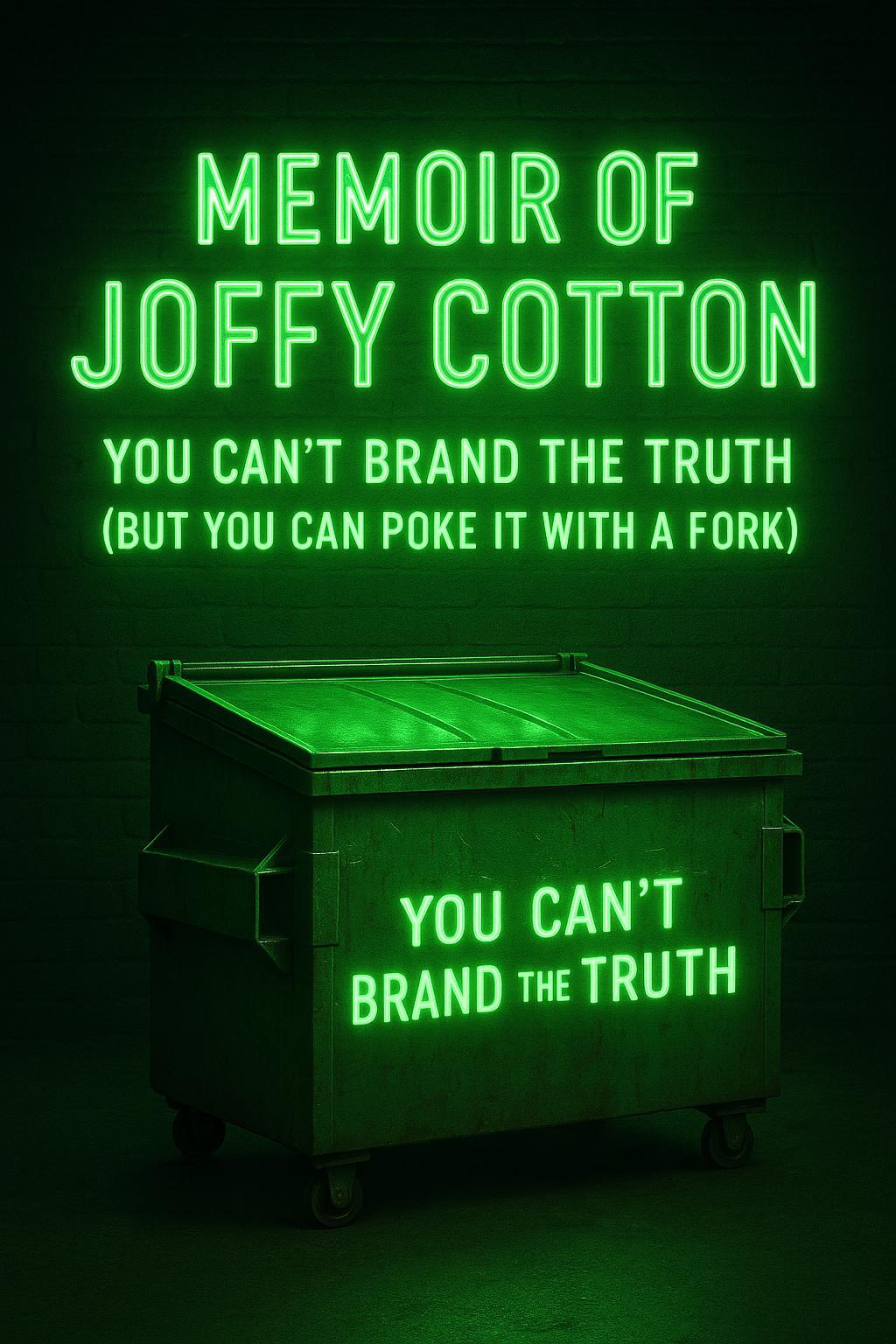
Front matter
Title page
Ricky Browne
Memoir of Joffy Cotton
You Can’t Brand the Truth (But You Can Poke It With a Fork)
Front matter
Copyright
Copyright © 2025 by Ricky Browne
All rights reserved. No part of this publication may be reproduced, stored, or transmitted in any form or by any means, electronic, mechanical, photocopying, recording, scanning, or otherwise without written permission from the publisher. It is illegal to copy this book, post it to a website, or distribute it by any other means without permission.
First edition
This book was professionally typeset on Reedsy
Find out more at reedsy.com
Front matter
Introduction
This is the story of a boy named Jacknife, born Joffy, formerly Moonlight, who was tossed into a skip bin at birth, raised by dumpster-diving hippies, and destined to save reality with a slightly magical fork.
It’s part memoir, part fever dream, part deep-fried philosophy wrapped in absurdity and served on a metaphorical plate of questionable purpose.
If you’re here for logic, linearity, or moral consistency—you took a wrong turn at Albuquerque. If you’re here to laugh, flinch, and wonder what the hell you just read—welcome.
Chapter 1 of 10
Chapter 1
In 1576, war broke out between France and Tiberia. France would go on to win, two-one, in a penalty shootout fourteen months later. The Tiberian Peninsula was renamed the New Paris Peninsula. Four hundred years after that, in 1977, three men—Charley, Harry, and Will—arrived in Botswana. There, they traded a wooden shield stolen from the Makiawata Tribe some three centuries earlier for a diamond-encrusted diamond that had once hung around the neck of Queen Mefratittie.
Ten weeks later, England recorded its hottest day on record. That same day, two of the three men died of the pox—possibly smallpox, or just an unusually aggressive rash from the local goat cheese. No one really knows. But what is known, and what matters more to me, is that on April the sixth, 1977, I came into the world.
What do all these things have in common? Probably not much. But I’m not here to talk about all that anyway.
When we come into this world, we are completely helpless—kind of like my half-sister’s 16-year-old son. After birth, we don’t have much. No Rolex, no diamond ring. We’re essentially born broke, clueless, and screaming. Unless you’re born into money—then you might still be clueless and screaming, but you’re doing it in a warmer room.
All babies are stupid. Even the clever ones. They can’t throw a ball or operate a slide whistle. My point is: babies are lame. They stay lame for a long time. But they’re also cute, so they get away with it. Like really bad open mic comedians.
When I was born, I must not have been that cute. My parents didn’t look at me and say, “Let’s nurture this tiny human until he’s less lame and slightly more useful.” Instead, they threw me in a skip bin behind a Chinese takeaway and pretended the whole thing was a phantom pregnancy—that thing where you think you’re pregnant, but it turns out you’ve just been lying to everyone while binging ice cream and donuts and watching reruns of Murder, She Wrote.
I would’ve surely died if it weren’t for a dreadlocked freegan couple who found me while dumpster diving for bagels. A freegan, for the uninitiated, is someone who eats trash on purpose—to save money and spite capitalism. Their names were Cody and Skylar. They loved me the way any drug-addled couple would—poorly, but with flashes of sincerity.
At least they didn’t toss me out like a six-inch tuna sub mistakenly ordered when someone clearly asked for chicken teriyaki.
Cody and Skylar were keen surfers but gave it up for drugs because they couldn’t afford their own boards. They named me Moonlight, but the National Naming Agency (yes, that’s a thing) rejected it as “too whimsical.” So, they called me Joffy instead. Cody and Skylar didn’t fight it because they were unassertive people who didn’t want to cause a scene—they once apologized to a goose for stepping near it.
Their last name was Cotton, so I became Joffy Cotton. They were half-brother and half-sister, but after hooking up a few times, they decided their DNA was dissimilar enough to make it official. The rest of the family didn’t object—because they were all dead, victims of the inner-city pineapple riots of the early ‘80s.
While my name on the certificate was Joffy, Cody and Skylar mostly called me Jacknife—because they thought it sounded cool and people would be less likely to mess with a kid named after a folding blade. Spoiler: they were wrong. I got punched in the neck twice before my second birthday.
Chapter 2 of 10
Chapter 2
Growing up as Jacknife Cotton was confusing. Not just because I had three names before I could spell my own—Joffy, Moonlight, and Jacknife—but because my childhood was anything but normal. For starters, we lived in an abandoned bowling alley that had been repurposed into a kombucha distillery and illegal ferret sanctuary.
Cody and Skylar made a modest living selling glow-in-the-dark tarot readings to passing truckers and disgraced politicians. Our house was powered entirely by a suspiciously strong child named Mungo, who ran in a hamster wheel hooked up to a car alternator. No one knew where Mungo came from, and he spoke only in riddles and Duran Duran lyrics.
Every morning, I was homeschooled by a sock puppet named Professor Garbanzo who had a strong Welsh accent and an uncomfortably detailed knowledge of 17th-century plumbing. I later found out Professor Garbanzo was just Skylar’s left hand, but by that point, I’d already written him three letters asking for a scholarship to Wales.
Lunch was usually expired hummus, dandelion bread, or whatever Mungo could catch in his net. One time it was a bird. Another time it was a real estate agent who’d gotten lost while canvassing the neighborhood. We let him go after he promised not to tell anyone what he saw. He now runs a cult in Idaho.
By the time I turned six, I had already:
- Built a glider out of egg cartons and human hair
- Been baptized by accident at a Scientology open day
- And briefly held the local record for “Most Consecutive Minutes Spinning While Crying” (23 minutes, 11 seconds)
That year, Cody decided I needed a “real male role model,” so he introduced me to a man named Uncle Razzmatazz. Uncle Razzmatazz wasn’t my uncle. He wasn’t anyone’s uncle. He just showed up at parks with a kazoo and a bird on his shoulder that may or may not have been taxidermied. His job title, according to his own business card, was “Hologram Consultant & Emotional Blackmailer.” I never saw him consult a hologram, but he once made a grown man cry just by winking at him. That’s a kind of power you don’t learn in school.
Anyway, Uncle Razzmatazz taught me a lot—like how to hypnotize vending machines, how to cry underwater, and how to fake a limp to gain sympathy in long queues. He was basically my spiritual mentor, though his main spiritual advice was “If you can’t beat them, distract them with glitter and run.”
One afternoon, he handed me a shovel and a map drawn in crayon. “Your destiny’s buried under the third lamppost near the haunted Payless Shoes,” he said, and disappeared in a puff of disappointment and hot dog steam.
I never found what was under the lamppost, but I did discover a strange urge to become something more than a weird little kid with too many aliases and a deep distrust of pineapples.
But I’m getting ahead of myself. That part comes later. First, I have to tell you about the time we accidentally started a commune in the middle of an IKEA.
Chapter 3 of 10
Chapter 3
It all started when Skylar said she needed a new ladle. Not just any ladle—a soul ladle, as she called it. “You’ll know it when you see it,” she whispered, eyes wide and pupils shaped like tiny spirals.
We packed up our worldly belongings (two sleeping bags, a half-melted lava lamp, and Mungo in a laundry basket) and hitched a ride in the back of a truck full of haunted mannequins bound for a seasonal display. The driver didn’t ask questions. Probably because Cody paid him in expired toothpaste and a copy of The Da Vinci Code with all the vowels removed.
When we arrived at IKEA, something happened. Something… mystical.
As soon as we entered the automatic doors, Skylar stopped dead in her tracks, dropped to her knees, and whispered, “This is it. This is the place the fridge ghosts told me about.”
The air smelled like MDF and artificial lingonberries. People around us were blissfully unaware that they were walking across what would soon become a sacred ground for a new civilization built entirely from self-assembly furniture and unfulfilled dreams.
We never left.
At first, we just stayed overnight by hiding inside a modular wardrobe named Gloopenblärr. Security didn’t notice because we disguised ourselves as a pile of novelty cushions with encouraging slogans like “Dream More Nap Harder” and “Live, Laugh, Asphyxiate”.
Soon, other weirdos joined us—escapees from various subcultures: a retired circus mime who only communicated via charades and smoke bombs, a woman who believed every chair was a portal to a parallel universe, and a conspiracy theorist who claimed IKEA was an acronym for Interdimensional Kittens Engineering Armageddon.
By the end of the first month, we had 63 residents. We named the settlement “Swedetopia.”
Our currency was Allen keys. Leadership was determined through competitive pillow fights and emotional vulnerability. Every Tuesday we held interpretive dance tribunals to settle disputes. If your dance sucked, you had to live in the cursed lighting section for a week with the flickering bulbs and haunted lampshades.
I was 9 at the time, and already the second-in-command after Skylar proclaimed me High Priest of Storage Solutions. My ceremonial staff was a bent curtain rod, and my teachings were mostly just me yelling “Put that back where it belongs!” and people mistaking it for metaphor.
Mungo thrived in Swedetopia. We gave him a full-sized hamster maze made from disassembled bunk beds. He became something of a local legend after defeating the Congealed Meatball Monster that had formed in the cafeteria’s dish pit after someone spilled cosmic syrup into the deep fryer.
But utopia never lasts.
One day, a man in a suit walked in. He had the unsettling air of someone who had never sneezed or blinked in his life. His name tag simply read “Björn: Corporate.”
He stared at our community, nodded slowly, and said, “You have desecrated the sacred layout.”
Then everything went black. When I woke up, I was outside, naked, wrapped in a meatball-stained rug, with a note stapled to my forehead that read, “Assembly Not Required.”
Swedetopia was gone.
Erased. As if it never existed. All that remained was a faint whiff of cinnamon bun and unresolved trauma.
That day marked the end of my innocence, and the beginning of my adolescence—a time filled with mistakes, love, loss, and an unfortunate incident involving a bagpipe, a goat, and a misinterpreted wedding invitation.
But we’ll get there.
Next, I need to tell you about my time at a school for gifted but emotionally unstable children run by a talking emu with a PhD in disappointment.
Chapter 4 of 10
Chapter 4
After the fall of Swedetopia, Cody and Skylar decided it was time I got a “proper education”—not just what I’d learned from interpretive dance court or Professor Garbanzo’s lectures on plumbing and paranoia. They enrolled me in The Euphoric Institute for Troubled Prodigies, a highly experimental boarding school built inside an abandoned amusement park and partially funded by the National Bean Council.
It was founded in 1922 by a wealthy Austrian lumberjack named Heinrich von Wobblethigh, who believed children learned best while mildly terrified. His legacy lived on through the school’s unconventional motto: “Fear Sharpens Genius.”
The principal was a six-foot-tall emu named Dr. Reginald Featherstone III. He wore a monocle, a threadbare corduroy blazer, and spoke with the clipped precision of a disappointed Oxford professor. No one knew how he’d earned his doctorate, but rumor had it he once out-debated a panel of economists using only wing gestures and passive-aggressive throat noises.
“Welcome to the Institute,” Dr. Featherstone had said on my first day, staring directly into my soul. “Here, we nurture brilliance. Or we break you trying.”
I was placed in Class Omega-7, also known as The Hazards. It was reserved for students who had either:
- Built functioning time machines out of spoons,
- Set fire to at least one library (accidentally or otherwise),
- Or spoken in tongues during Parent-Teacher Night.
There was:
- Luna, who could astral project but only while sneezing.
- Boris, who could memorize entire books in seconds but compulsively lied about his height.
- Tiffany, who had the ability to talk to plants, but only if they were mildly depressed.
- And Dwayne, who was just really, really good at staring contests. Like suspiciously good.
Our curriculum included:
- Quantum Woodwork
- Emotional Algebra
- The Ethics of Sorcery
- And Advanced Recess: a full-contact psychological battleground.
Instead of detentions, we were subjected to Existential Isolation Chambers, where we had to assemble IKEA furniture while listening to ambient whale sounds and being berated in Swedish.
Dr. Featherstone didn’t teach per se—he mostly roamed the halls at midnight, tapping on lockers and whispering cryptic phrases like “The key is beneath the unripe banana,” and “Never trust a mime with dry hands.”
But despite the chaos, something strange happened. I thrived.
By week three, I’d invented a hat that could detect sarcasm (unfortunately, it exploded if worn near teenagers), and composed a 300-page philosophical treatise titled “Why Cereal is Soup and You Are a Coward.” It was immediately banned by the school board and nominated for a national award in Latvia.
But my success didn’t go unnoticed. I had caught the eye—or rather, the shimmering compound gaze—of The Council of Janitors, a secretive order of mop-wielding mystics who maintained the school and governed the underfloor black market.
One of them approached me in the cafeteria one day. He slid a note across the table. It was written in mustard. It read:
“Meet us at Locker 666. Midnight. Bring banana peels.”
That meeting would change everything.
But I’m getting ahead of myself again.
Before I can explain how I accidentally became Head of Espionage and Fruit Logistics, I have to tell you about the forbidden romance between a sentient vending machine and a hall monitor named Craig.
Chapter 5 of 10
Chapter 5
Her name was SNACKTRON-9000, but those who knew her intimately just called her Snacks. She stood near the east stairwell, humming gently with electricity and soft jazz. Her keypad was sticky with time, her snack coils twisted with wisdom. She wasn’t just a vending machine—she was an oracle, a confidante, and, allegedly, a jazz flautist in a past life.
And then there was Craig.
Craig wore his hall monitor sash like it was a badge of honor. He took his job seriously—too seriously. He once tackled a kid for walking three-and-a-half seconds after the bell rang. No one had the heart to tell him the bell was just the fire alarm again.
Craig was earnest, nervous, and shaped like a Tetris piece that didn’t quite fit. He believed in rules.
Until he met her.
No one knows exactly when it started. Some say Craig would talk to Snacks during his break, whispering insecurities and asking for guidance. Others claimed they saw him slowly feeding her coins—not for food, but as a gesture of devotion.
Whatever the origin, their love blossomed like a fungal bloom in a forgotten thermos.
Late at night, I would see Craig sitting beside her, reading her poems he’d written in scented ink. Titles like “Your Circuitry, My Soul”, “Eternal Nachos,” and the devastatingly vulnerable “Press B7 For My Heart.”
She never spoke aloud—her voice came in clicks and whirs, in the subtle trembling of her cola dispenser. But Craig understood her. He heard her in ways no one else could.
They kept their relationship quiet—partially because interspecies mechanical love was heavily frowned upon under the Euphoric Institute’s ethics charter, and partially because the last student who dated a locker mysteriously disappeared into the ventilation system and came back speaking only in haiku.
Things were going well… until the New Snack Machine arrived.
It was sleek. It was digital. It had a touchscreen.
Its name? Vendr.
Vendr had Bluetooth, a live-streaming feature, and dispensed cold brew lattes with motivational quotes printed on the ice cubes. The students were mesmerized. Even some of the janitors defected.
Snacks started to flicker. Her coils slowed. Her chip bags sagged in sadness. Craig could feel her pain, and he grew increasingly desperate. He challenged Vendr to a duel—an ancient and forbidden tradition known as Snack-Off.
Each machine had to vend its most meaningful item.
Vendr dropped a flawlessly chilled kombucha and a protein bar that cost more than Craig’s self-esteem.
Snacks hesitated. Then, with a buzz and a grind of aged gears, she offered up a single, slightly melted Choco-Lament Bar—a discontinued candy from 1984 known to trigger intense emotional flashbacks in those who ate it.
A hush fell over the school.
Craig stepped forward, unwrapped the bar, and bit into it.
He immediately began sobbing and reciting the lyrics to Careless Whisper. Even Dr. Featherstone shed a tear—though it may have been allergies.
The judges, which were three mildly psychic frogs kept in a jar for moments just like this, declared Snacks the winner.
But victory came at a cost. The strain was too much. Her inner circuitry overloaded with emotion and high-fructose corn syrup. Snacks powered down permanently, her final light blinking out like a dying star.
Craig mourned. For weeks he wandered the halls, whispering to vending machines, trying to feel a spark. But there was no one like her. There never would be.
He left the school shortly after, citing “irreconcilable differences with reality.” The last I heard, he was managing a roller rink in New Mexico and writing vending-machine-themed erotica under the pen name Sasha Crunchlove.
But I never forgot them. The love. The sacrifice. The chocolate.
And it was around this time—while processing all that love and lactose—that I was kidnapped by a traveling cult of nihilist mimes who believed the universe was just one long invisible wall.
But that’s a story for another day.
Chapter 6 of 10
Chapter 6
It happened on a Tuesday, which—as any mystic worth their salt will tell you—is the most kidnap-friendly day of the week. I was on my way back from Emotional Algebra class, where we’d just graphed our abandonment issues using pie charts and actual pie, when I saw them.
Four of them. Faces painted white. All black clothing. One was trapped in an invisible box. Another was pretending to climb a rope made of sadness. The third one simply stared at a rubber duck on the ground for a full ten minutes without blinking.
The fourth mime beckoned.
I blinked. He beckoned again, but slower, like a sad jellyfish summoning prey.
Something inside me said, Don’t go near the mimes.
But something louder said, What’s the worst that could happen?
(The answer was “quite a lot.”)
As soon as I stepped closer, they struck—silently, of course. A burlap sack dropped over my head. I felt a tug, a spin, a brief jazz hands sequence, and then… darkness.
When I came to, I was in what appeared to be a warehouse full of furniture made of sadness and existential dread. The air smelled like greasepaint and regret. I was surrounded by dozens of mimes, all completely silent, all performing simultaneously contradictory pantomimes. One was rowing a boat; another was being hit by a boat. Several were pretending to be toilets. I tried not to take that personally.
Eventually, their leader arrived.
He was known only as The Quiet One.
He wore a massive top hat filled with sand and had a single teardrop painted on each elbow. He didn’t speak—not because he couldn’t, but because he refused. His mind, they told me through aggressive charades, was “too loud for words.” I was immediately promoted to Novice of The Unseen Grasp—a fancy title meaning “Kid Who Might Be Useful Later.”
Over the following weeks, I was initiated into their sacred mime rituals:
- The Ritual of the Infinite Wall, where you try to escape but you can’t, which was both a metaphor and also just real.
- The Great Glass Windstorm, which involved flailing wildly while maintaining intense eye contact with a potted fern.
- And The Sacred Shrug, their highest form of spiritual surrender.
Their philosophy was simple:
“Life is meaningless, but at least it’s silent.”
They believed the universe itself was a mime—silent, invisible, and mostly misunderstood. According to their scriptures (which were blank books stacked for dramatic effect), sound was a lie and everything from music to soup slurping was a form of cosmic arrogance.
I tried to escape three times. Each time I was mime-tackled mid-sprint by a highly trained “invisible horse battalion.” I still have psychological hoof marks.
Eventually, I realized the only way out was in. I fully embraced the mime within. I painted my face, donned the suspenders, and became one of them.
They trusted me. I was given access to their deepest secrets—like where they kept their emergency noisemakers (inside a fake rubber duck) and the fact that one of them, Todd, was secretly a beatboxer named DJ Whisper.
It all came to a head during the Annual Silent Scream Festival, where everyone climbed a cliff and pretended to scream into the void for spiritual release. I used the opportunity to launch my escape plan.
I performed the Legendary Fake Echo Routine, luring them to the edge one by one as I mimed hearing their thoughts out loud. It was hypnotic. They leaned closer… closer…
Then I vanished—ducking into a passing hot air balloon piloted by a confused clown named Patrice, who thought I was a lost suitcase.
As we drifted into the sunset, I looked back at the mime cult below, still miming confusion, betrayal, and one of them doing The Macarena for reasons no one ever understood.
I was free.
Emotionally unstable, possibly cursed, and now extremely good at charades… but free.
Chapter 7 of 10
Chapter 7
Patrice the Clown had never flown a hot air balloon before.
“I thought this was a bouncy castle,” he said cheerfully, wearing a t-shirt that read “Send in the Clowns, But Only If They’re Qualified”.
To his credit, we stayed airborne for an impressive forty-seven minutes before Patrice mistook a weather vane for a joystick and yelled, “Activate landing protocols!” while hurling confetti into the burner.
The descent was less a landing and more a polite crash. We tore through a flock of confused storks, clipped the top of a scarecrow dressed as Prince, and finally came to a halt in a clearing surrounded by llamas. Dozens of them. Judging us.
One stepped forward. It wore a monocle.
“Welcome,” it said telepathically. “To Llamalot.”
I assumed I had suffered a concussion, but Patrice just nodded like this was normal.
Llamalot was a secret llama commune hidden in the Andes-adjacent region of somewhere-between-Argentina-and-plot-convenience. The llamas had built an entire civilization—complete with irrigation, a stock exchange, and a disturbingly efficient bureaucracy.
They were ruled by High Chancellor Gustavo the Even-Toed, a wise old llama with a limp and an MBA in International Relations. He spoke entirely in soft humming noises, which were translated for me by Jerry, a disgraced Google Translate AI implanted into a coconut.
Jerry told me I had landed in the middle of a llama election cycle. Their current mayor—Fernando the Fuzzy Bastard—had been ousted for misappropriating hay bales and using public funds to build a velvet portrait of himself playing poker with ancient Incan gods.
Desperate for a new leader, the llamas turned to me.
“You’ve got a strong jawline and a vague sense of authority,” said Jerry Coconut.
“You’ll do.”
I protested.
“I don’t even live here. I’ve never paid llama taxes. I once ate an alpaca burger—am I even eligible?”
Too late. I was sworn in during a ceremonial spit circle and gifted the Sash of Slight Leadership, which smelled faintly of vinegar and compromise.
As mayor, I had many responsibilities:
- Mediating disputes over whose wool was fluffier
- Approving new laws like “Llamas May Not Moon Tourists Unless Provoked”
- And hosting weekly town meetings inside a giant slipper named Kevin
I initiated several progressive reforms:
- Free sunglasses for all llamas
- A universal basic income of carrots
- And mandatory jazzercise every second Thursday
Things were going great until I accidentally signed a treaty with a neighboring goat cartel known as The Horned Order. The fine print, which was written in Comic Sans and blood, stated that I had agreed to hand over the entire population of Llamalot as “emotional support livestock.”
This did not go over well.
The llamas revolted. Politely. With banners that said things like “WE RESPECTFULLY DISAGREE” and “DOWN WITH THE BUREAUCRATIC COCONUT.”
I was exiled at dawn on the back of a rogue unicycling alpaca named Sandra.
As we rode into the fog, Jerry the Coconut whispered, “You did your best, Joffy. But democracy’s a fickle llama.”
He exploded shortly after. Turns out coconuts don’t handle emotional pressure well.
That’s how I ended up, once again, homeless, disgraced, and riding a monocycle-powered animal toward an uncertain future.
But destiny wasn’t done with me yet.
Because two days later, I woke up in a room with no windows, a talking ceiling fan, and a man who claimed to be the ghost of a future version of myself. And he had a plan.
Chapter 8 of 10
Chapter 8
I awoke on a mattress that felt like it had been constructed entirely from unspoken childhood trauma and packing peanuts. The room was silent, except for the steady whir-whir-whir of a ceiling fan with googly eyes stuck to it.
“Ah, you’re awake,” said the fan.
I blinked. “Are… are you talking?”
“Technically, I’m translating,” it replied. “He speaks through oscillations. I’m just the vessel. The messenger. The wind whisperer. Also, I’m Greg.”
“Who’s he?”
From the shadows emerged a translucent figure—glowing faintly, wearing a Hawaiian shirt, Crocs, and an expression that screamed, “I’ve seen too much and now I make smoothies to cope.”
“I’m you,” he said. “From approximately 38 alternate timelines in the future.”
I stared.
He stared back.
Then we both said, in unison:
“Damn, we’ve aged weird.”
He sat beside me, hovering slightly above the mattress like a man unsure if he has permission to sit on his own memories.
“I’m not technically a ghost,” he explained. “I’m a temporal echo with unresolved personal issues and a subscription to Better Moods Monthly. I’ve come to help you fix your timeline before it unravels into what historians refer to as The Great Yogurt Incident.”
I didn’t ask about the yogurt yet. I wasn’t ready.
Future Me pulled out a small chalkboard from thin air and began drawing a diagram that looked suspiciously like a sad jellyfish trying to file taxes.
“Right now,” he said, “you’re at a critical junction point. Everything you’ve done—being raised by dumpster-diving incest hippies, founding a rogue IKEA commune, falling in love with vending machine literature, and being democratically ousted by political llamas—has all led you to this moment.”
“…Okay,” I said slowly. “So what’s the plan?”
“First,” Future Me said, “you must find the Fork of Ultimate Potential.”
I blinked.
“It’s a literal fork,” he confirmed. “Silver. Wobbly. Imbued with the power to disrupt reality and stir exceptionally dense oatmeal. It’s been buried inside the spleen of a sleeping volcano goat named Philip.”
“Where is this goat?”
“In Belgium.”
I stared at him.
“You expect me to go to Belgium and dig inside a goat to retrieve a magical utensil?”
Future Me leaned forward, his voice serious now. “You must. Otherwise, the Anti-Joffy rises.”
“The… Anti-Joffy?”
Greg the ceiling fan let out a low, mournful whir.
Future Me nodded grimly. “Yes. You know that little voice in your head that tells you to do something stupid? That voice is real. It lives. It has legs now. And it recently got tenure at a questionable university. It’s gathering followers. Influencers. Failed magicians. Middle managers. They’re forming… a pyramid scheme of doom.”
My heart sank.
“What’s it selling?”
“Motivational beanbags filled with lies,” he whispered.
I stood up. Or tried to. I slipped on a loose existential crisis and landed on a pile of damp tax forms.
But I knew what I had to do.
Find the fork. Defeat the Anti-Joffy. Probably ride a goat.
And hopefully, along the way, make peace with the fact that my life had gone full absurdist prophetic casserole.
Chapter 9 of 10
Chapter 9
Belgium greeted me with suspicious weather and a suspicious customs agent named Chaz, who spoke only in riddles and demanded I solve a Sudoku before stamping my passport.
After five hours and a minor emotional breakdown in a Brussels vending machine lounge (I miss Snacks…), I finally boarded a creaky train bound for the remote village of Lavaflomme—known for three things:
- World-class volcano goats.
- An annual festival where people dress as various types of cheese.
- An extremely confusing municipal slogan: “Lavaflomme: You Know What You Did.”
Upon arrival, I was greeted by a tour guide named Clémentine, a woman with one eyebrow and seventeen conspiracy theories. She wore a poncho made of laminated soup recipes and carried a broom labeled Not For Sweeping, Unless It’s Spiritual.
She didn’t ask why I came. She just looked me in the eye and said, “You seek the goat.”
“Yes,” I replied. “The volcano one. Philip.”
She squinted. “Philip is ancient. Angry. Constantly smoldering. Like a French ex-boyfriend. Are you sure you’re ready?”
I nodded solemnly, though inside, my spleen was staging a protest.
We hiked up Mount Goatcha, an active but emotionally distant volcano. The path was littered with burnt baguettes, ash clouds, and motivational graffiti like “YOU CAN’T MILK DESTINY” and “SURRENDER TO THE GOAT.”
At the summit, there he stood.
Philip.
The goat. The legend. The lukewarm myth.
He was massive, snoring molten breath, with lava trickling from his horns and a suspicious glint in his eye. Carved into the volcano behind him were the words: “Do Not Touch the Goat Unless Your Intentions Are Pure or at Least Sarcastic.”
I approached carefully, holding out the ceremonial offering: a tinfoil-wrapped croissant shaped like a fork.
Philip opened one eye. The earth shook. My stomach made a noise that translated loosely to “I regret everything.”
Then he spoke—not in words, but in a sound that resembled an ocarina being played by a panicked goose.
Clémentine translated:
“He says: The fork is within, but so is lunch. Proceed quickly.”
I nodded, took a deep breath, and retrieved the fork.
It was… underwhelming.
A small, slightly bent silver utensil with the faint smell of birthday candles and misplaced ambition. But when I held it up, the air shimmered. A nearby cloud saluted. A passing bird laid an egg shaped like a question mark.
This was it. The Fork of Ultimate Potential.
Then suddenly—lightning struck! The sky split open like a piñata of prophecy. Out stepped three robed figures wearing salad bowls for hats and glowing aprons.
“Who dares claim the Wobble Fork?” one intoned.
“I do,” I said, fork held high and anxiety held slightly higher.
They bowed.
“We are the Guild of Slightly Magical Cutlery,” the middle one said. “Keepers of the Spork Scrolls, masters of the Teaspoon Riddles, and sworn enemies of dull butter knives.”
They welcomed me into their fold, right there on the volcanic summit, with a ritual involving flaming fondue and a pun-based chant:
“Forkward! Forkward! Never Sporkward!”
They told me the truth: I was the Chosen Utensilist, foretold in ancient dishware prophecy, destined to wield the Wobble Fork to stir the soup of time, poke holes in the fabric of oppression, and battle the rising force of the Anti-Joffy.
I asked them if this was some kind of prank or metaphor.
They handed me a business card that said:
“Nope. This is very real. Please do not eat this card.”
So now I had the fork, the truth, and a guild full of fanatical utensil wizards behind me.
But we were running out of time.
The Anti-Joffy had already begun his plan: infiltrating minds through inspirational Facebook posts and personalized MLM schemes selling scented regret.
The final battle wasn’t just coming.
It was being catered.
Chapter 10 of 10
Chapter 10
News of Anti-Joffy’s rise came via an urgent transmission delivered by a pigeon wearing a tiny cape and muttering the word “synergy” under its breath. It crash-landed into the Guild’s Fondue Room and exploded into a cloud of glitter and unsolicited stock advice.
The message was clear:
Anti-Joffy had launched his empire—JOFFŌ™, a lifestyle brand built entirely on charisma, self-doubt, and discount peppermint oil.
He was recruiting.
His ranks included:
- Former cult leaders who’d rebranded as motivational speakers.
- Disillusioned baristas with high emotional intelligence and weaponized latte art.
- An entire battalion of chinchillas trained in passive-aggressive eye contact.
His base? A luxury pyramid-shaped floating spa called The Ascension Cube, hovering over a disputed parking lot in Croatia.
It was time to fight back.
The Guild told me I’d need to assemble a crew—a Fellowship of the Fork—each member representing a different aspect of my absurd, trauma-seasoned, vending-machine-romanced life.
First stop: Mungo.
I found him running a moderately successful gym for emotionally repressed toddlers. He was still muscular, still only communicating via primal grunts and early-2000s ringtone melodies. When I told him the world needed him, he chest-thumped so hard a nearby yoga instructor achieved spontaneous enlightenment.
He was in.
Next, we visited Luna—my old classmate from the Euphoric Institute. She was now running a black-market sneeze meditation retreat in the Himalayas.
“You want me to astral project into battle?” she asked, while levitating over a vat of mint-scented tofu.
I nodded.
She sneezed, vanished, and a note floated down: “See you at the end. Bring tissues.”
We moved fast. The Anti-Joffy was broadcasting his message through every screen, speaker, and Bluetooth-enabled fridge. He spoke in slogans that made your soul itch:
- “Be your best lie.”
- “Disrupt the truth.”
- “Have you considered monetizing your identity today?”
I gathered:
- Craig the Hall Monitor, who had left the roller rink to become a vigilante relationship therapist. He still wore the sash. He still mourned Snacks.
- Patrice the Clown, now a deeply respected life coach among amphibians.
- Greg the Ceiling Fan, reincarnated as a sentient drone with sass.
And yes—even Sandra the unicycling alpaca, who had seen things no alpaca should see. She didn’t speak, but she knew.
Then came our final recruit:
Chancellor Gustavo the Llama, exiled from Llamalot after being caught selling faux-intellectual NFTs of dramatic haystacks. He agreed to join only if he could wear a cape made of unread philosophy books. We accepted.
Our team was weird, wildly unstable, and barely bonded by a shared understanding of linear time—but we were ready.
We trained in the mountains of Mildredonia, under the tutelage of an ancient cutlery monk who only spoke in chopstick haikus. He taught us the ways of the Fork Kata—the ancient art of poking holes in oppressive narratives and lightly scrambling the fragile eggs of ego.
The final trial was at dawn.
We stood at the edge of reality, the Wobble Fork glowing with potential, our hearts full of strange confidence and vague dread.
The battle was coming.
Anti-Joffy awaited in his floating cube of curated despair.
And I…
I was beginning to remember who I really was.
A baby once thrown in a skip bin.
Raised by freegans.
Forged in IKEA.
Tested by vending machine heartbreak, mime cult captivity, and political llama betrayal.
Now?
I was about to save the world.
With a bent fork.
Back matter
Conclusion
The sky cracked open like a bag of undercooked popcorn.
Above us, The Ascension Cube hovered—monolithic, smug, and sponsored by seventeen different cryptocurrency startups that had already gone bankrupt mid-hover. Its surface shimmered with holographic affirmations like “Rise Above Your Lower Self (and Also Pay for the Platinum Plan)” and “Authenticity Starts With Our Merch.”
Inside was Anti-Joffy, my mirror-self gone rogue.
He had everything I didn’t: laser teeth, consistent branding, and 14.3 million followers who all referred to themselves as “Rikettes.”
We floated up via llama-powered dirigible. Sandra piloted it like a pro, steering with nothing but leg twitches and silent disapproval.
As we docked at Cube Level 7 (The Reality Editing Deck), I turned to the Fellowship of the Fork. They nodded—some with courage, some with mild confusion, one because they misunderstood the question.
We entered.
The hallways were lined with neon signs like “Hustle or Die Slightly Bored” and “Feeling is a Choice—So Stop It.” A self-help audiobook narrated by a robot with daddy issues echoed through the corridors.
Then we reached the core.
Anti-Joffy stood there, atop a throne made entirely of podcast microphones and shredded therapist notes.
He turned slowly, his eyes glowing the color of freshly charged ego.
“Well, well,” he said. His voice sounded like mine but with more crypto confidence. “The original. The reject. The unbranded prototype. Come to stop me with… a fork?”
I stepped forward. “It’s a Wobble Fork, actually. Slightly magical. Fully meaningful.”
He laughed. “You think you can stop my empire? My funnel-based emotional supremacy machine? My followers believe in me. They bought my detox inner-child candles. They’ve already enrolled in ‘Mastering Your Light Shadow for $997.’ You’re too late.”
But I wasn’t alone.
Craig stepped forward and held up his hall monitor sash, which glowed with the power of relentless moral consistency.
Mungo roared and ripped off his shirt, revealing an eight-pack and a motivational slogan tattooed across his chest: “Shhh.”
Luna appeared mid-sneeze from the astral plane, briefly possessed by a Victorian librarian.
Sandra spat dramatically.
And Patrice the Clown unleashed his secret weapon: balloon animals of pure emotional catharsis.
Anti-Joffy scoffed. “You brought feelings to a weaponized mindset battle?”
“No,” I said. “I brought me.”
I raised the fork.
It hummed. Reality bent. The algorithm flinched.
With a mighty scramble, I plunged the Wobble Fork into the floor.
The Cube glitched. The monetized affirmations began to autocorrect into uncomfortable truths:
- “Self-love can’t be monetized.”
- “You are not a brand. You’re a very sweaty human being.”
- “You don’t need a subscription to feel worthy.”
Anti-Joffy screamed, twisting and pixelating.
“You can’t just embrace uncertainty! You’ll lose followers!”
“Good,” I said. “Maybe they’ll find themselves instead.”
And with one final surge of awkward sincerity, the Cube collapsed inward, sucked into a vortex of cancelled sponsorships and unclaimed NFTs.
When the dust settled, there was silence.
Real silence.
No hype. No hustle.
Just… being.
We stood there, dazed, victorious, and kind of hungry.
“You did it,” whispered Patrice. “You forked reality.”
“I did,” I said. “And now I kind of want soup.”
Back matter
Epilogue
Epilogue: The Aftermath of The Fork
Life slowly returned to something resembling normal.
Mungo opened a meditation gym where you scream into buckets.
Luna founded an emotional sneeze therapy startup.
Sandra became an alpaca ambassador to the U.N.
Craig finally forgave the vending machine (but never forgot).
And me?
I kept the fork.
Mounted it on my wall next to a framed photo of Philip the Volcano Goat and a quote that reads:
“Reality’s a mess. Stir responsibly.”