Applied Optimalism: A Mindset for Navigating Truth - Part III
How to think, believe, and act for what’s most beneficial — not just what feels true.
Flourishing Through Uncertainty
Humanity’s next leap forward will come from how we think, not what we think. Applied Optimalism is a framework for flourishing by navigating truth, beliefs, and decision-making without falling into absolutism. It asks not for blind faith in reason, but for an upgrade to the mental software that runs our civilisation.
Yet, we can upgrade our minds. We can create new frameworks for thinking. The question becomes: how do we choose the optimal framework for our minds? What kind of software do we want to run on our hardware?
I believe it is software that combats and overcomes the tribal mind wherever possible. The tribal mind, to me, is the biggest problem we face when it comes to building functional, flourishing societies — societies that take care of externalities to ensure our ongoing existence.
The tribal mindset once ensured cohesion within a tribe and helped it compete with other tribes for survival. But in an interconnected world, this wiring causes countless issues that humanity repeatedly faces.
That is what Optimalism exists to address.
Optimalism is about shifting the odds — increasing the likelihood of beneficial outcomes and reducing the likelihood of destructive ones.
The tribal mindset is both dangerous and weak. It prevents individuals from making optimal decisions for themselves or society and leaves them easily co-opted by bad actors — who often don’t even see themselves as bad, because they too are running on tribal firmware.
From Tribal Thinking to Optimal Thinking
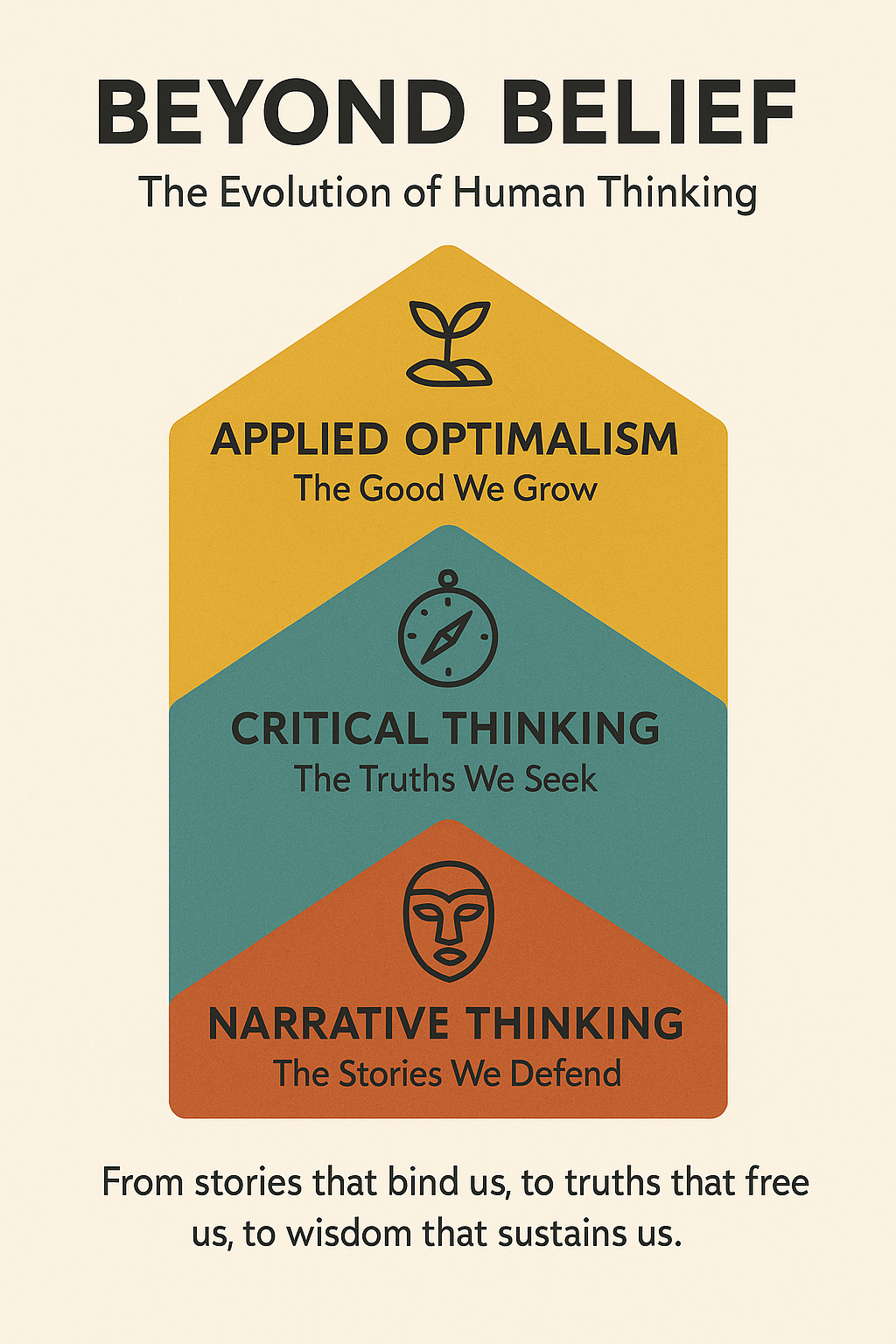
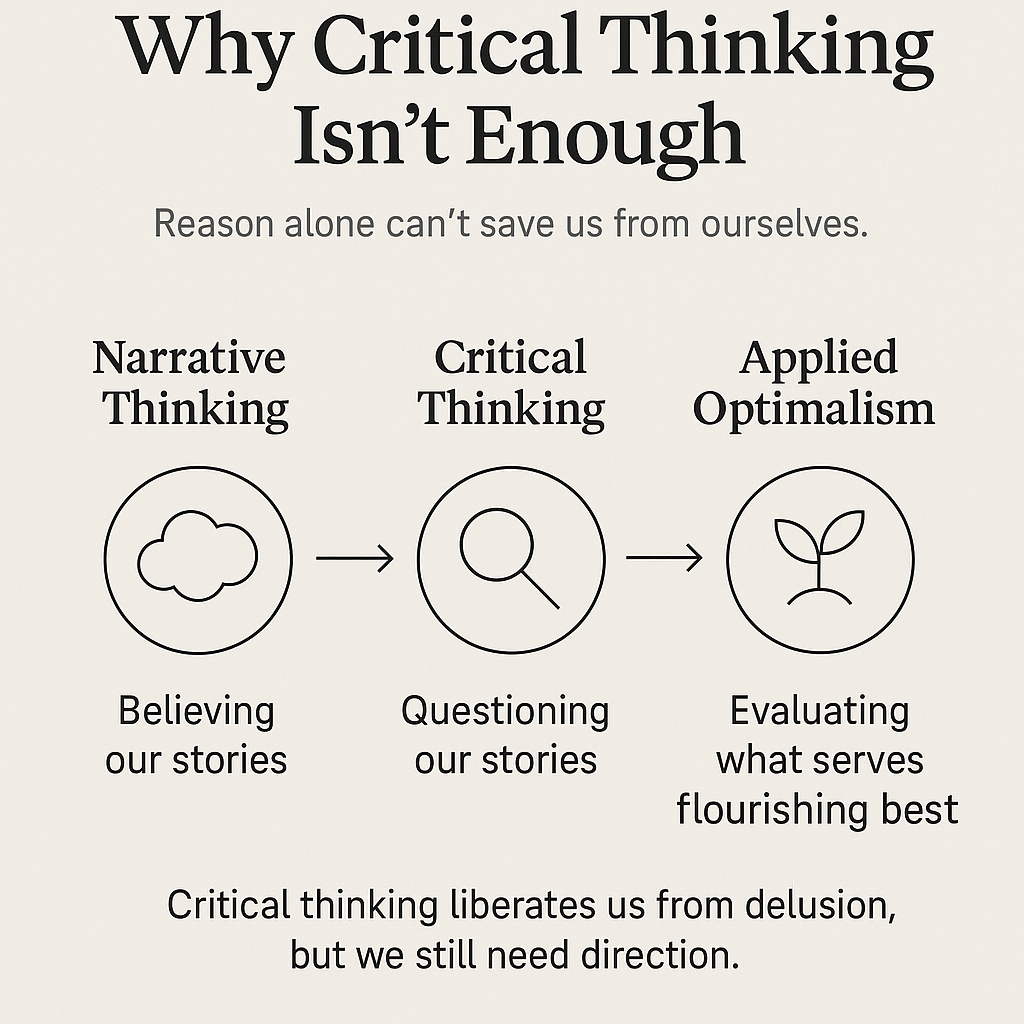
Most people live inside stories. They inherit beliefs from their families, cultures, and political tribes, then build an identity around them. These stories bring comfort and belonging, but they rarely aim at truth. They aim at cohesion.
The next step in human reasoning is to move from narrative thinking — the tribal mode of defending stories — to optimal thinking, where the goal is not to win arguments or preserve identity, but to find what works best for life as a whole.
What Is Applied Optimalism?
Applied Optimalism is the practice of evaluating beliefs, behaviours, and systems by their contribution to flourishing, rather than their claim to certainty.
In this context, flourishing means the sustained well-being and functional harmony of individuals, societies, and ecosystems.
It accepts that we live in an uncertain world — one where complete truth is rarely attainable, but better outcomes are. It asks:
- Is this belief useful?
- Is it aligned with fairness, compassion, and integrity?
- Does it create more harmony or more harm?
If a belief improves well-being, supports ethical cooperation, and helps life flourish, then it is functionally true enough to matter.
The Optimality Test: Three Dimensions
To keep “optimal” from being vague, we can evaluate beliefs across three dimensions:
- Personal Optimality – Does it improve mental health, awareness, and integrity?
- Social Optimality – Does it strengthen trust, fairness, and cooperation?
- Ecological Optimality – Does it sustain the natural systems that life depends on?
A belief or behaviour that passes all three is both rational and ethical. If it fails any one, it may be comforting but globally harmful.
Truforming integrates these three dimensions into a single process of alignment. To Truform is to live optimally within oneself, within society, and within the living system that sustains both.
How Optimalism Differs from Utilitarianism
Optimalism is not simple utilitarianism.
Utilitarianism seeks to maximise happiness or pleasure for the greatest number.
Optimalism seeks to maximise flourishing — a richer concept that includes truth, meaning, fairness, sustainability, and psychological growth.
Where utilitarianism measures quantity of pleasure, optimalism measures quality of consequence. It recognises that long-term well-being often requires short-term discomfort, honesty, and self-correction.
Fuzzy Likelihoods and Reality Testing
Reality rarely deals in absolutes. Most claims fall along a spectrum of likelihood and consequence.
When evaluating an idea, Applied Optimalism uses fuzzy likelihoods — a mental tool for grading beliefs not just by how likely they are to be true, but by how much they matter if acted upon:
- Highly Probable – Supported by strong evidence.
- Plausible – Reasonable but uncertain.
- Unlikely but Beneficial – Probably untrue, yet psychologically stabilising or socially constructive.
- Unlikely and Harmful – Probably untrue and destructive to individuals or society.
This model helps you focus on what truly matters: improving life outcomes while staying grounded in reality.
Truth as a Tool, Not a Trophy
Truth is sacred, but not all truths are equal in consequence.
Some truths liberate; others simply wound.
A truth that destroys trust or well-being without serving a higher correction is not wisdom — it’s ego disguised as honesty.
Optimalism doesn’t abandon truth; it ranks it by consequence. It asks not only, “Is this true?” but “What are the consequences of believing this?”
The Psychology of Optimal Thinking
Psychology explains how we form, protect, and rationalise our beliefs. By understanding these mechanisms, we can consciously rewire them.
Three key psychological processes drive Personal Optimalism:
- Individuation – Becoming a whole and authentic individual.
- Differentiation – Maintaining your own identity while engaging constructively with others.
- Integration – Aligning your beliefs, actions, and values toward flourishing.
These are also the psychological foundations of Truforming. Together they move a person from inherited belief toward self-directed consciousness — from tribal identity to authentic being.
Personal Optimalism means using psychology, self-awareness, and reason to live at your highest possible level of alignment — not as an act of selfishness, but as a contribution to a healthier world.
The Emotional Dimension
Thinking optimally requires emotional maturity. Logic alone cannot navigate human complexity.
Emotional intelligence provides the stability to question yourself without falling into self-loathing, and the empathy to challenge others without cruelty.
Equanimity, humility, and curiosity are emotional tools of optimal thought. They allow reason to operate without arrogance and compassion to act without naivety.
A Remedy for Cognitive Pitfalls
Applied Optimalism is an antidote to the extremes of human thought:
- Superstition – Believing without evidence.
- Scientism – Believing only what can be measured.
- Cynicism – Believing in nothing.
- Ideological Possession – Becoming owned by your beliefs rather than owning them.
The goal is balance — enough doubt to stay honest, enough conviction to act with purpose.
The Optimal Belief Spectrum
The goal is not to reject all unprovable beliefs, but to cultivate the ones that guide life toward flourishing while rejecting those that divide or degrade.
The Dumb Smart People Problem
Intelligence does not guarantee wisdom. Many brilliant individuals use reason to rationalise bias and preserve ideology.
Optimalism calls this The Dumb Smart People Problem — when intellect serves identity instead of insight.
The cure is not more intelligence, but better alignment: truth plus compassion equals wisdom.
From Survival Thinking to Flourishing Thinking
For most of human history, belief evolved for survival, not truth. We believed what held tribes together and justified power structures.
But our environment has changed. Now, survival depends on cooperation and empathy across tribal lines. Our thinking must evolve accordingly — from survival cognition to flourishing cognition.
Applied Optimalism is that evolutionary step: a model for navigating truth and belief in an interconnected world.
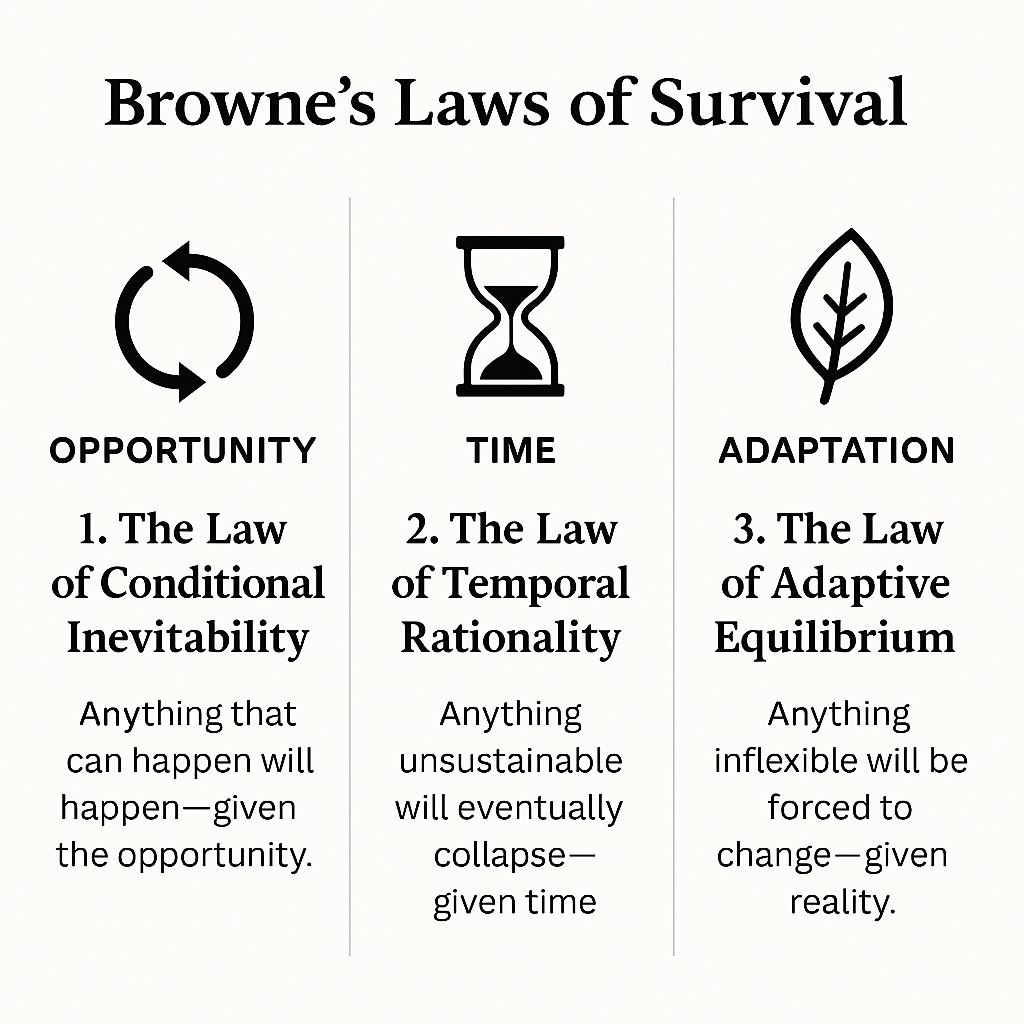
Browne’s Law of Conditional Inevitability
Murphy’s Law says if something can go wrong, it will.
Browne’s Law adds the essential caveat: “Anything that can happen will happen — given the opportunity.”
The message: potential is constant, but opportunity is conditional.
We cannot remove possibility from existence, but we can reduce the conditions that make harm likely.
Browne’s Law also applies to growth: anything that can become better will — given the opportunity.
Truforming is the act of creating those opportunities within ourselves and our societies.
Whether in personal habits or global politics, wisdom lies in reducing destructive opportunities and expanding constructive ones.
Optimal thinking is the conscious application of that law.
Browne’s Second Law extends this principle through time: anything unsustainable will eventually collapse, given time.
If the first law defines how opportunity shapes outcomes, the second defines how duration reveals truth.
Together, they form the temporal and ethical core of Applied Optimalism — reminding us that reason must not only prevent harm now, but ensure survival later.
Browne’s Third Law extends this philosophy into behaviour: anything inflexible will be forced to change, given reality.
Optimal thinking is living alignment — not rigid belief.
A belief, system, or person that refuses to adapt to new data or deeper truth will eventually be adapted by circumstance.
In this sense, adaptability is not weakness; it is intelligence across time.
Ethical Guardrails
To prevent “optimal” from being twisted into selfish pragmatism, two constraints define its moral boundaries:
- The Constraint of Compassion – A belief or system cannot be optimal if it harms others or the biosphere.
- The Constraint of Integrity – A belief cannot be optimal if it requires self-deception or dishonesty.
Optimal outcomes cannot emerge from corrupt motives.
Truforming: Living the Framework
Applied Optimalism teaches us how to think clearly and act ethically within uncertainty.
Truforming is the next step — living that clarity.
To Truform is to become the healthiest, most authentic version of yourself, aligned not only with your own potential but with what helps life itself to flourish. It is the antidote to tribalism: a process of evolving beyond fear-based thinking into a mode of existence grounded in awareness, integrity, and compassion.
On a personal level, Truforming is about becoming the optimal expression of who you are.
On a collective level, it is about humanity reaching its optimal expression as a species — moving beyond survival into flourishing.
Applied Optimalism gives us the philosophy.
Truforming gives us the path.
The Future of Thought
Applied Optimalism unites logic, psychology, and compassion into a coherent approach to life. It is humility in action — a way to think and live that favours adaptability over ideology, and fairness over tribal victory.
The next leap in human progress will not come from technology or politics, but from a change in our mental architecture: from binary certainty to optimal reasoning.
When truth is uncertain, aim for what is most beneficial.
When belief is unavoidable, choose the one that helps life thrive.
The principles of Applied Optimalism naturally extend beyond the individual. When entire systems think and act optimally, we move toward Societal Optimalism — governance and cooperation guided by fairness, truth, and sustainability rather than tribal interest.
That is Applied Optimalism.
Blurb
Truth alone is not enough. Applied Optimalism is a mindset for evaluating beliefs by their benefit to self, society, and planet — using psychology, fuzzy likelihoods, and compassion to navigate a world without absolutes.
Author Note
Written by Ricky Browne, creator of Truforming & Level Up at Life — exploring how truth, awareness, and compassion can guide humanity beyond tribalism and self-deception.